.png)

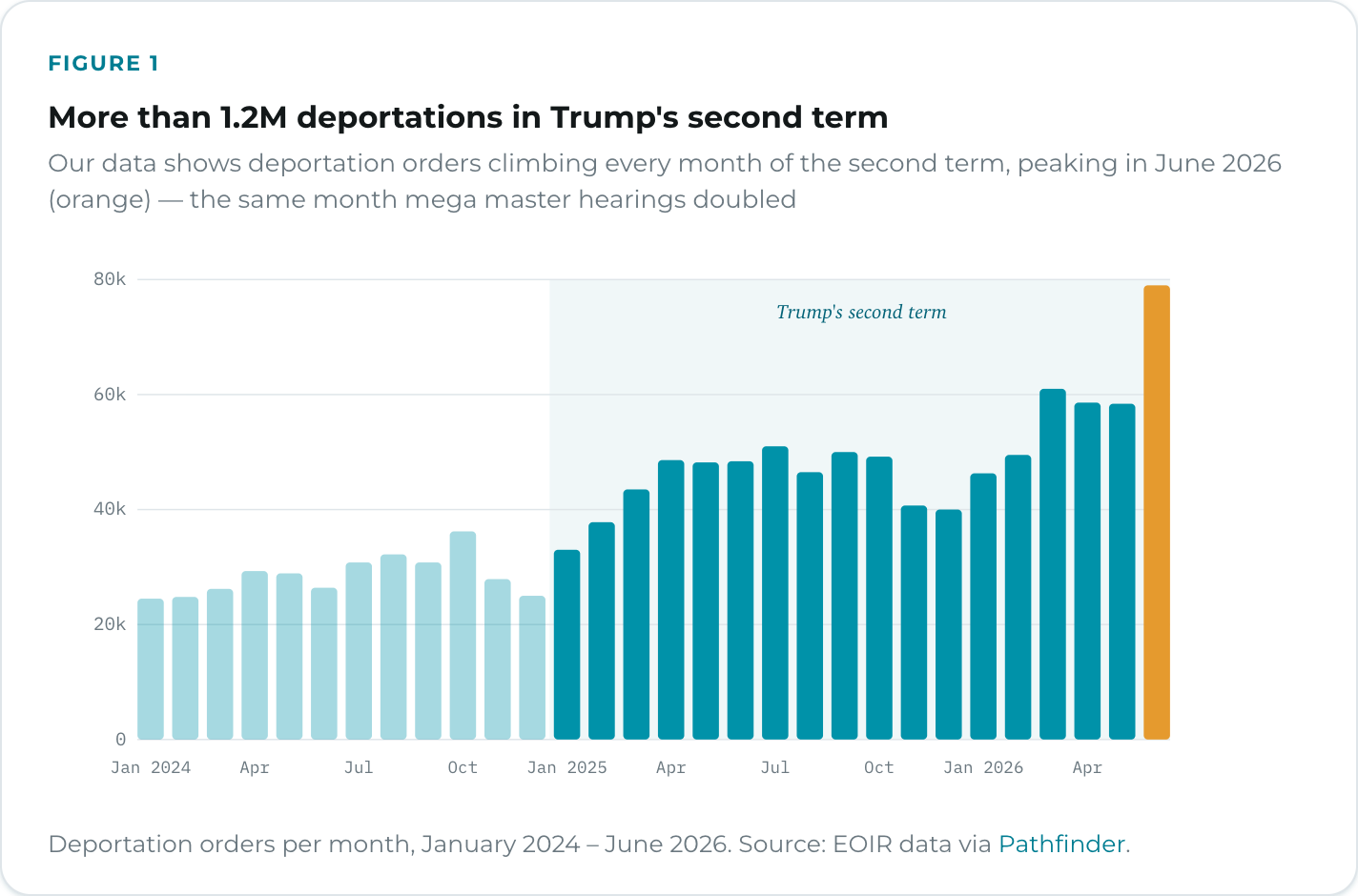
Something is fundamentally changing in America's immigration courts, and the numbers are impossible to ignore. As we've been reporting alongside the Associated Press and NPR, who partnered with Mobile Pathways to get exclusive data and context, a single judge now presides over dozens, sometimes hundreds, of people in one half-day session. These "mega master" hearings doubled in size last month alone, and on those packed dockets, immigrants are being deported at accelerating rates, their cases vanishing from the system faster than at any point in the court's history. The result: deportation orders are climbing month after month, now past 1.2 million this term.
Here's the hard math at the center of Mega Masters: asylum cases are being "abandoned" at nearly five times the historical average, and 2025–2026 already exceeds the prior three administrations combined. But what does "abandoned" really mean? Are fake asylum claims going "poof" as people skip hearings, or were these cases never decided at all, just closed because the system booked more people than it could hear?
This is not a question we are asking alone. We first flagged the pattern last month, and in the weeks since we have shared our data with the American Immigration Lawyers Association, the Acacia Center for Justice, the American Immigration Council, Austin Kocher, former immigration judges, and many other immigration nonprofits. This breaking story has struck a chord, with coverage in nearly 1,000 outlets internationally. It's also reaching new audiences for Mobile Pathways, including the Haitian Times and Chinese-language press like World Journal.
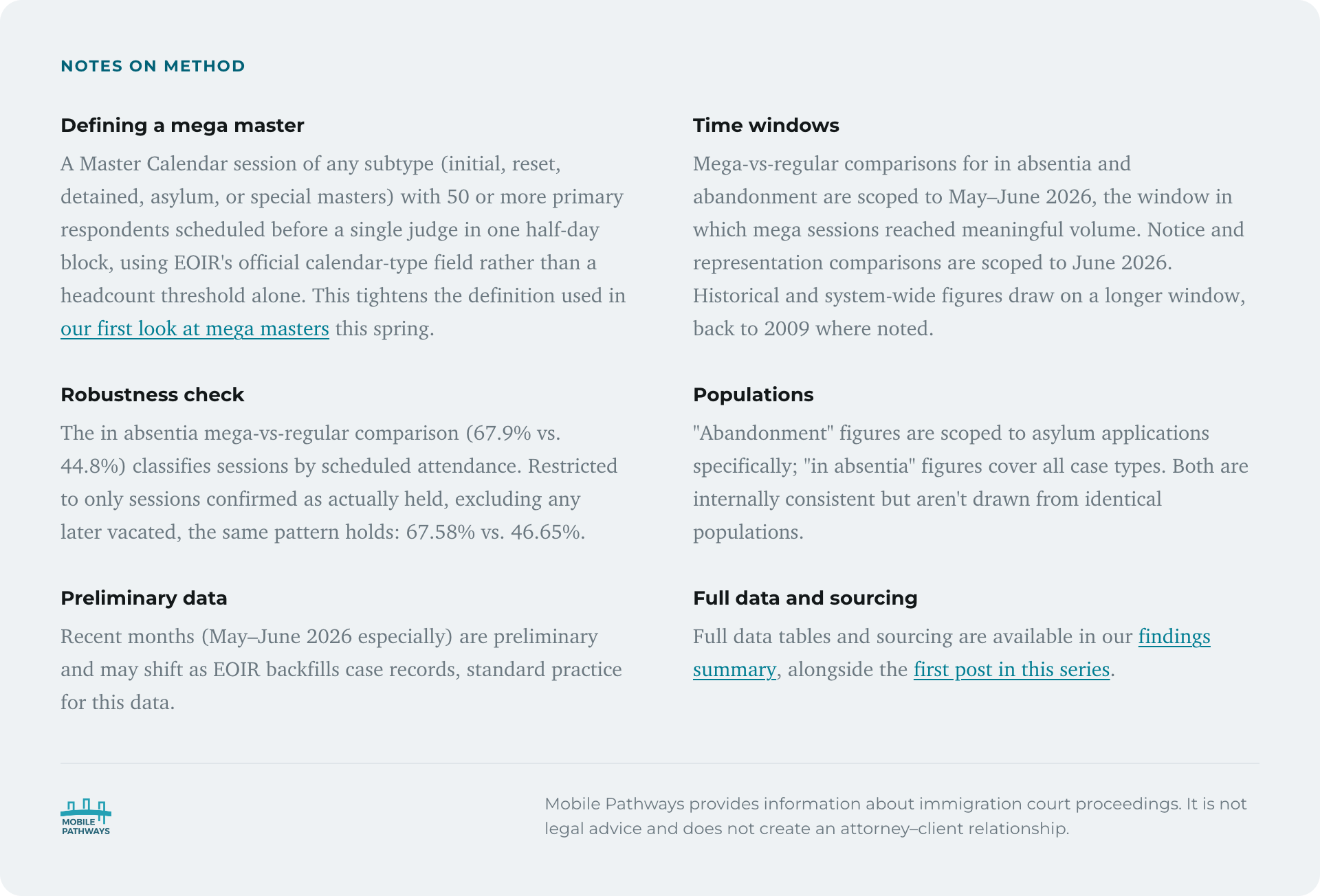
Now that the press embargo has lifted, let's look at what the data actually shows, both short and long term. This is a summary of our findings on Mega-Masters and plummeting asylum rates, written for a general audience. For a detailed analysis, read my colleague Camila Feltrin's report here.
First, large-volume dockets are nothing new. What has changed is the sheer scale at which they now operate. Since 2020, mega master sessions have grown from a rounding error to the defining feature of the court calendar, and the sharpest jump came last month.

More People Miss Court than Make it
In plain terms, an in absentia order means the court decided your case because you did not appear. As a result of mega masters, in certain cities more people are missing court than ever before; the rates of in absentia "no show" deportations have roughly doubled compared with historical norms, and in some cities missing court is now the majority outcome. Put simply, more immigrants miss their case than make it. And the stakes could not be harsher: 99% of in absentia cases end in a deportation order. No testimony, no evidence, no hearing on the merits.
Removal orders are dramatically up across the board from May to June, with the sharpest rises in Harlingen and Chicago, the same courts where mega master sessions are most intense relative to their size.
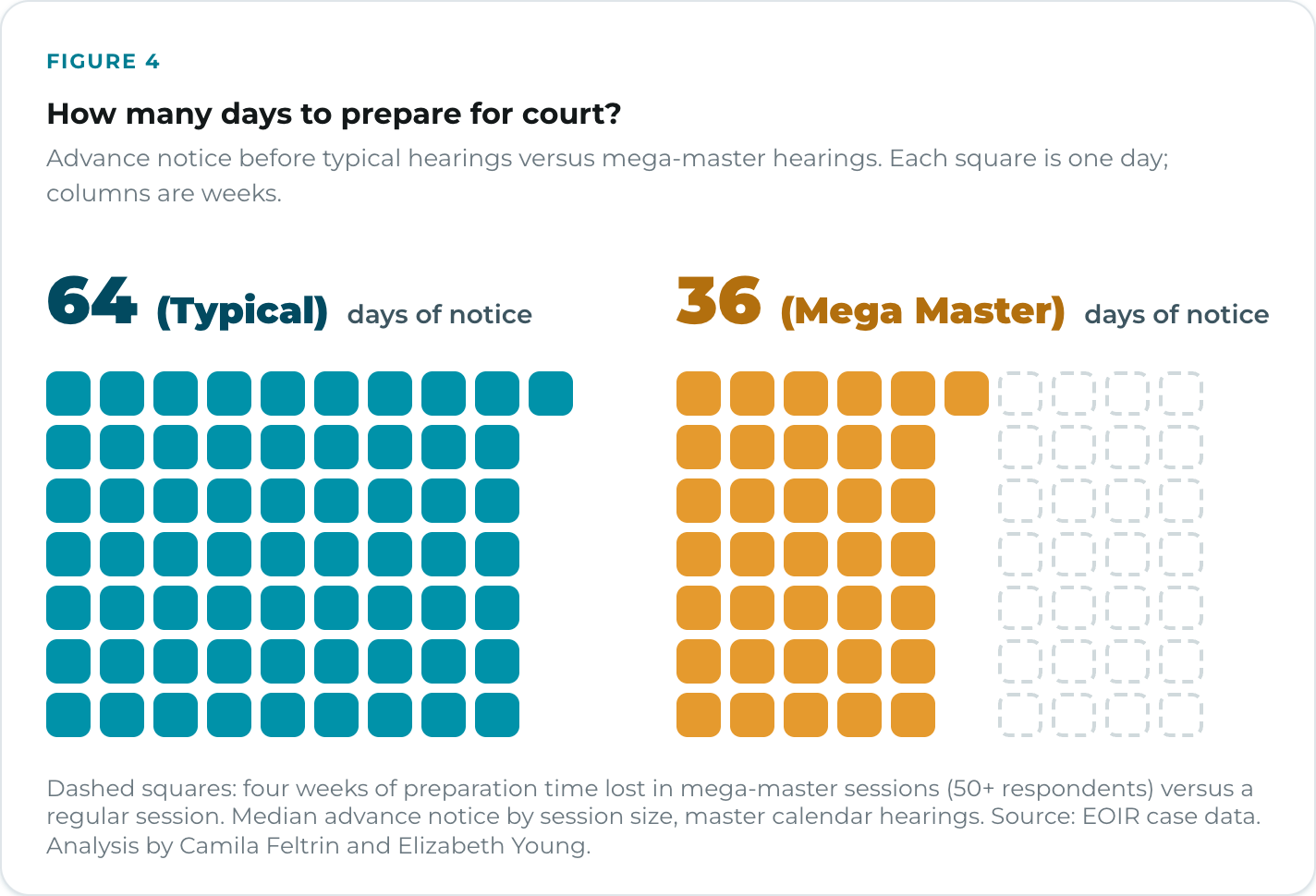
But why would a packed docket cause someone to miss their own hearing? The answer is in how little warning people are getting.

The data in Figure 3 are an approximation. The Executive Office of Immigration Review (EOIR) data cannot account for nuances it never captures — when the postage stamp was added, when the letter was actually received, or when the orders were processed by the clerk. But what court observers nationwide are telling us fills in the picture, perhaps best explained as analogy.
Imagine receiving a letter ordering you to appear at the DMV in less than three days, so you cancel work, rearrange appointments, maybe bring your children along, and arrive at 7:30 a.m. to find a line already stretching out the door. After waiting for hours, you're handed a notice saying you never needed to appear at all. As we're hearing from our partners at the Acacia Center for Justice, this is happening more and more.
Like most analogies, it's imperfect as a DMV visit doesn't require legal counsel or making sure your attorney can attend. But the confusion of those long lines paired with little time to organize is real, and the Associated Press captured the summation the true intent quite well in our interview with their team:

The Abandonment Surge
With mega masters surging and notices to appear plummeting, what are the outcomes? Deportations are rising in lockstep with the mega master trend. But the next finding is what most interests our team: asylum abandonment rates now run far above historical norms, nearly five times the national average. More asylum cases have been abandoned under the current administration than under the previous three combined, going back to the Obama era.The surge tracks closely with the rise of mega masters: as those sessions became routine, abandonments climbed in parallel. Against seventeen years of asylum outcomes, this is not the continuation of an existing trend but a break from it. If the current pace holds through the end of the year, abandonments will roughly double last year's total while grants continue to fall.
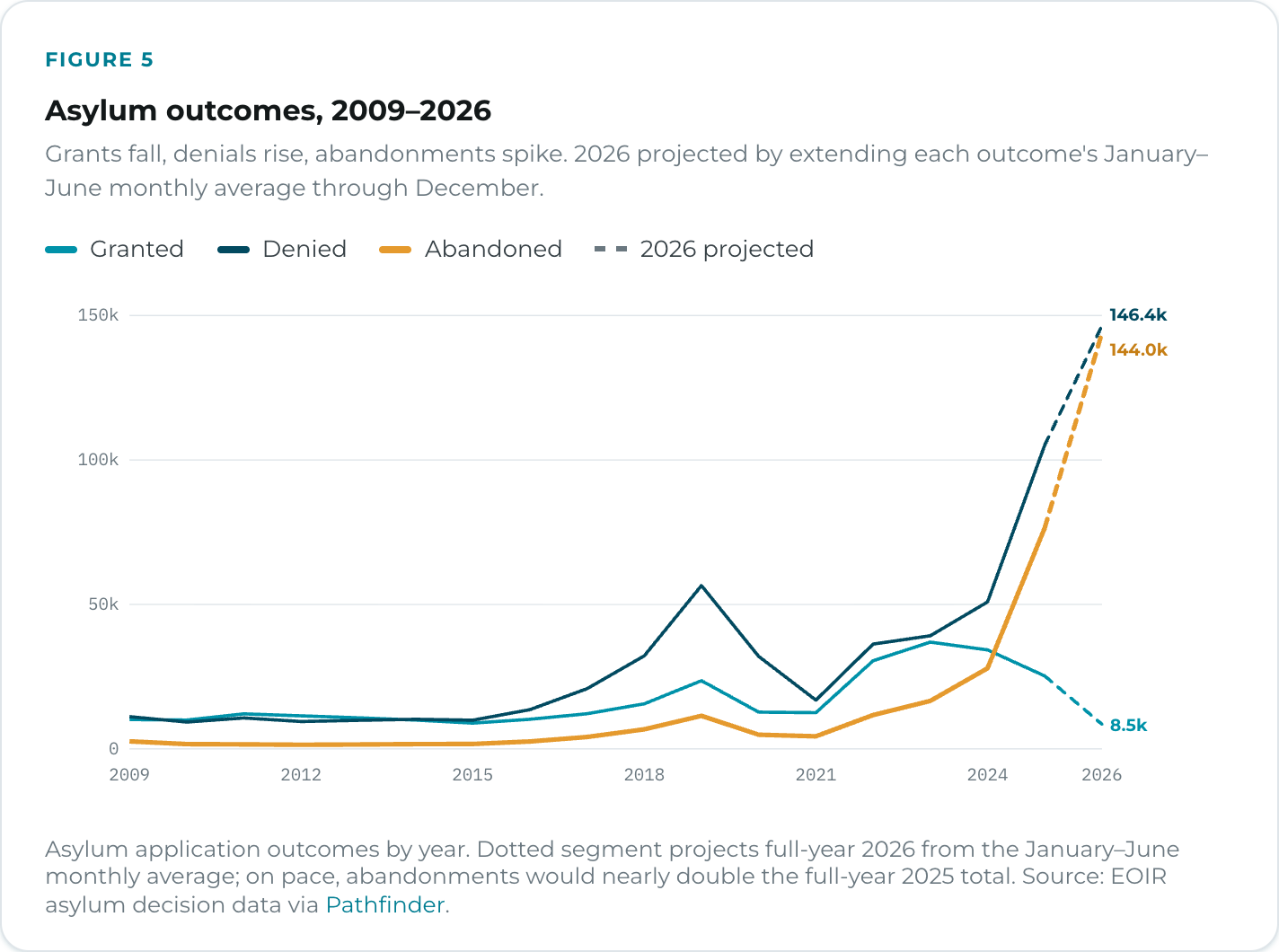
The crossover happened in May, the same month mega masters began scaling. That is not a coincidence. The gap blew open in June, when abandonments outnumbered denials by more than 5,000 cases.
Week by week, the pattern is unmistakable. National abandonments held near 2,500 a week through the spring, climbed as mega masters scaled in mid-May, and hit 6,124 in the last full week of June, two and a half times the January level. Chicago and Dallas more than tripled. Often these hearings happen first thing in the morning, with Dallas courts seeing a huge jump of 7:30am hearings in May and June.

Abandoned, Not Absent
So what's my take? Start with the word itself. To abandon something means to desert it, leave it behind, or completely give it up — a choice made by its owner, caretaker, or creator. That's the whole premise of the word: the person in charge decided to walk away.
That is not what is happening here. "Abandoned" is a court code, not a description of what happened. After conferring with our nationwide network of immigration practitioners and court observers, we're learning that hardly anybody here walked away from their claim. They were scheduled into sessions the system could not meaningfully hold, and their cases were closed on paper as if they had chosen to give up.
On a spreadsheet, that's an "abandonment." In real life, it's a family that did everything the system asked and lost their case anyway.
The distinction matters. A narrative of mass no-shows is recasting asylum seekers as indifferent to the law, when the record shows a procedural failure, not a personal one. That's why Mobile Pathways and our partner nonprofits are treating this as urgent: the mislabel is hardening the story before the due-process problem it hides is ever addressed.
The label says abandoned.
The data says abandoned by the system.