
.png)

Read in Spanish | Leer en español
A few weeks ago, Mobile Pathways had the privilege of working behind the scenes on an Associated Press investigation that followed people who thought they were going in for routine immigration court hearings, only to discover that the courtroom itself had become a deportation trap.
Here’s the hard math at the center of this story: your odds of being arrested at court are overwhelmingly slim, but if you miss your hearing, there is roughly a 99% chance you’ll be ordered deported.
So how do you decide what to when the courtroom itself has become a deportation trap?
We estimate the AP story has now reached well over 10 million people which is extraordinary visibility for Mobile Pathways. But every vivid story of a parent handcuffed outside a courtroom both exposes courthouse arrests and risks deepening the fear that keeps others from showing up at all.
That fear isn’t abstract; it leaves fingerprints in the data. By comparing ICE and EOIR records from this summer’s hearings when court arrests spiked, we now know the odds of what happens if you show up versus if you miss court.
In other words, here’s the brutal decision tree facing every immigrant in court today. *
A Lottery You’re Meant to Lose
.png)
At Mobile Pathways, we analyzed EOIR hearing data for May, June, and July 2025. Across those three months, there were 364,262 immigration court hearings nationwide.
The arrest side of the story comes from someone else’s painstaking work. Mathematician Joseph Gunther, drawing on ICE data published by the Data Deportation Project, developed a careful method for matching ICE arrest records with immigration court events and identifying arrests that most likely happened in or just after court hearings. Using that method, he identified 2,388 people — including 76 children — who were likely arrested at or immediately after court during that same three-month period.
We’ve reviewed his methods and find them highly credible. Lined up with our hearing counts, the result is stark: about one arrest for every 100 hearings.
On a spreadsheet, that’s a “small” number, well under one percent.
In real life, it’s a parent who was snatched in a courthouse hallway by masked officers while her children (ages 9 and 11) watched, stricken with fear and horror. They were left stranded in the hallway, as their mother disappeared into detention after doing everything the system asked.
Exactly the scenes the AP story captured so vividly, one could argue intentionally violent so the media would cover the fear factor in greater circulation.
When Court is All Fear

Data can tell us a lot with remarkable precision. It can tell us how many hearings happened, how many arrests are tightly linked to those hearings, and how many people were ordered deported because they did not appear before an immigration judge.
What it can’t show us is the moment someone reads that AP article on their phone, looks at their own hearing notice on the fridge, and quietly decides they simply cannot risk walking into that building.
That decision doesn’t show up as “fear” or “trauma.” It shows up as an in absentia removal order.
In plain terms, an in absentia removal order is when the court orders an immigrant deported for not showing up.
When ICE is visibly present in and around immigration courts, when stories of courthouse arrests multiply, and when word spreads that cases dismissed by a judge can still end in handcuffs outside the courtroom doors, communities do not experience that as a technical policy shift.
ICE's presence is a confirmation that the court itself may be a trap. To underscore the word trap, consider the outcome of missing even one case for an immigrant:
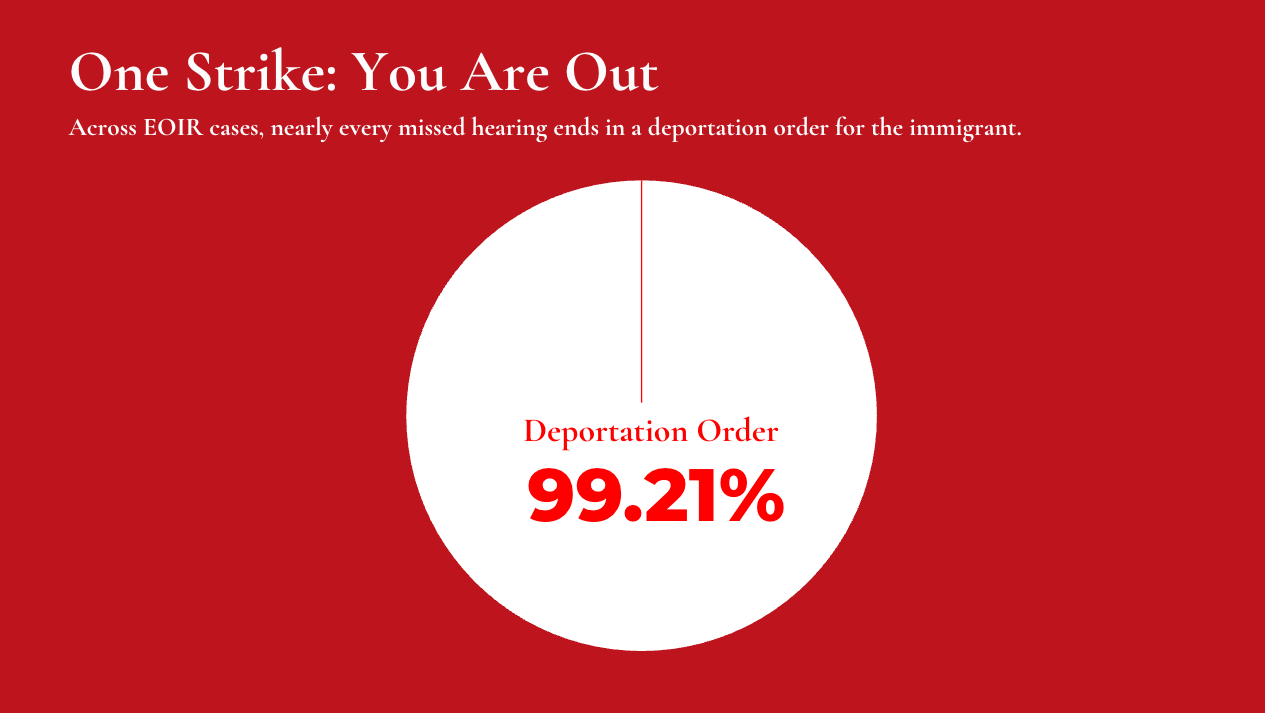
In our data, missing a court hearing is coded simply as a “no-show.” In reality, that means you lost your opportunity to fight your case. You are kicked out.
The current administration and the Department of Justice understand this loophole, and are actively leveraging it. By creating conditions that push people to miss their hearings, the system can then characterize them as indifferent to the law and deport them in absentia. It is a highly strategic, and deeply troubling, legal trap.
The question remains: is this calculated strategy actually working as intended?
Trapped Between the Law and Your Life
On paper, the choice is a brutal decision tree.
If you go to court, our best estimates suggest about a 1-in-100 chance that your hearing ends in an arrest and everything that can follow: detention, expedited removal, separation from your kids.
If you stay home, the math is even harsher: EOIR court data shows that missing even one hearing results with a 99.21% chance of being ordered deported.
No testimony, no evidence, no hearing on the merits. Miss a hearing? You are out of here.Faced with such a cruel decision, how are immigrants reacting nationwide? In the analysis below, we focus on asylum seekers, who make up the largest share of people in immigration court and are among the most vulnerable, fleeing persecution and violence.
They are quite literally trapped between the law and their lives: a missed hearing in the process can mean being sent back to the very dangers they escaped. Immigration Judge Dana Leigh Marks once described these proceedings as “death penalty cases in a traffic court setting,” capturing how life-or-death decisions are being made in a system that often feels rushed, technical, and overwhelmed.
Here’s what happens when this community faces that brutal decision tree, and the results are grim.
Arrested for Obeying the Law
Given the fear in immigrant communities and the steady drumbeat of media stories about courthouse arrests, you might expect to see people start staying home from court.
And you would be right.
Mobile Pathways’ analysis of recent asylum seeker data confirms that more asylum seekers are now missing their hearings, as families make impossible choices under mounting pressure.
.png)
Under this administration, in absentia deportations (read: courtroom "no shows") are rising, especially for asylum seekers.
The numbers are not exploding in a hockey-stick surge, but the direction is clear: more people are being ordered deported simply because they are too afraid to walk into a courthouse that might double as a trap.
That grim shift is happening even after years of two powerful countervailing forces.
First is the quiet, daily work of immigration nonprofits and legal service providers: every one of our partners at Mobile Pathways tells clients the same thing: the law is sacred; follow it.
Any immigration attorney is ethically and legally bound to tell their clients that, however cruel the system may feel, showing up is still supposed to be their safest option.
Second is the sheer resolve of immigrants themselves, determined to stand before a judge and tell their story, however imperfect the system may be. For years, that resolve held the line against fear. Now, courtroom arrests and viral media clips are eroding that trust. People are being asked to make an impossible choice: obey the law and risk being grabbed in the hallway, or stay home and be deported on paper.
It’s hard to imagine anything more Kafkaesque: you follow the rules, show up to court, sit before the judge, and then leave in handcuffs, not with justice.
None of that terror appears in any EOIR spreadsheet, yet it’s what spouses, pastors, and attorneys whisper about every day. As fear spreads, more immigrants are being pushed into the cruelest of corners: punished whether they show up or stay home.
* Editor's Note: Given the volatility of immigration law and the complexity of these datasets, there is always a risk of interpreting trends too quickly. If you’d like to discuss our data analysis methodology in more detail, please connect with us.


