
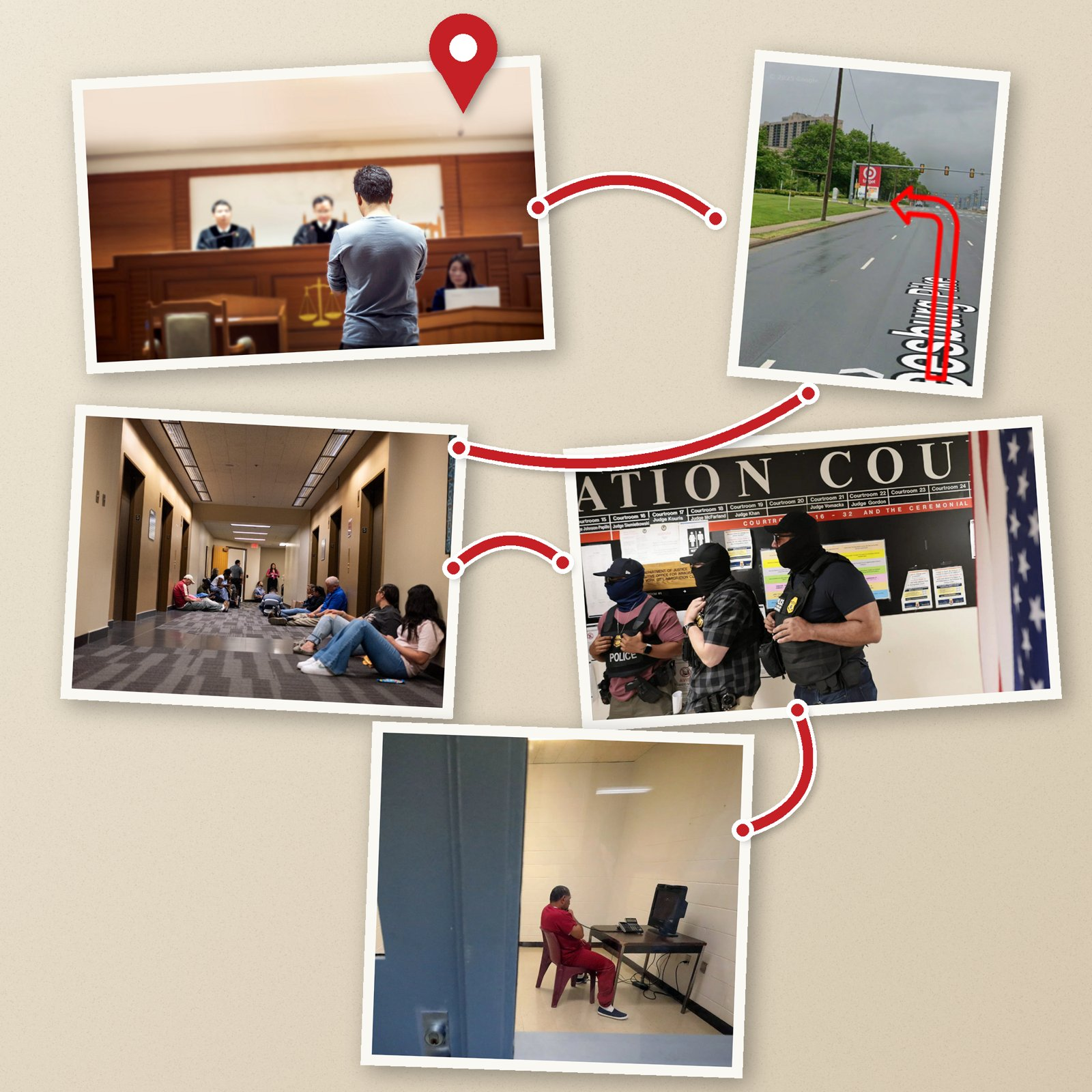

Immigration courts are popping up in new places across the country. In recent months, Pathfinder AIDE has found an alarming number of new hearing locations that don’t appear on any official court list, and we understand many more may be opening soon. And the early outcomes from these sites are troubling. In the large majority of completed cases, people were ordered removed without ever appearing before a judge.
On its face, more immigration court locations should help ease the backlog. But are these new sites truly opening new avenues for justice, or for deportations?
What is an Immigration Court?
It may seem like an odd question. In practice, it’s surprisingly hard to answer. Is it:
- A physical courthouse, like the one in Chicago?
- A table with a laptop inside a detention facility?
- A conference room in a federal office building, with a judge appearing by video from another state?
- Something in between?
There is no clear legal definition. EOIR itself says immigration courts sit in many kinds of spaces, including federal office buildings, detention facilities, and correctional facilities. The question matters, because the answer shapes whether people can find their hearing, bring a lawyer, and get a fair shot at justice.
With the blistering rise of new hearing locations, we’re seeing dozens open in questionable places. Our goal isn’t to redefine what an immigration court is. It’s to define what these “pop-up” courts are, as reported by our media partners at NPR and Bloomberg Law. That’s why Mobile Pathways is working with the Acacia Center for Justice, other immigration nonprofits, the media, and researcher Austin Kocher on a shared working definition, so we get these terms right.
With the nebulous concept of an immigration court in mind, here’s how we have attempted to define these new “pop-up” immigration courts.For this analysis, we set aside detention-based courts and focus on sites where non-detained immigrants are ordered to appear.
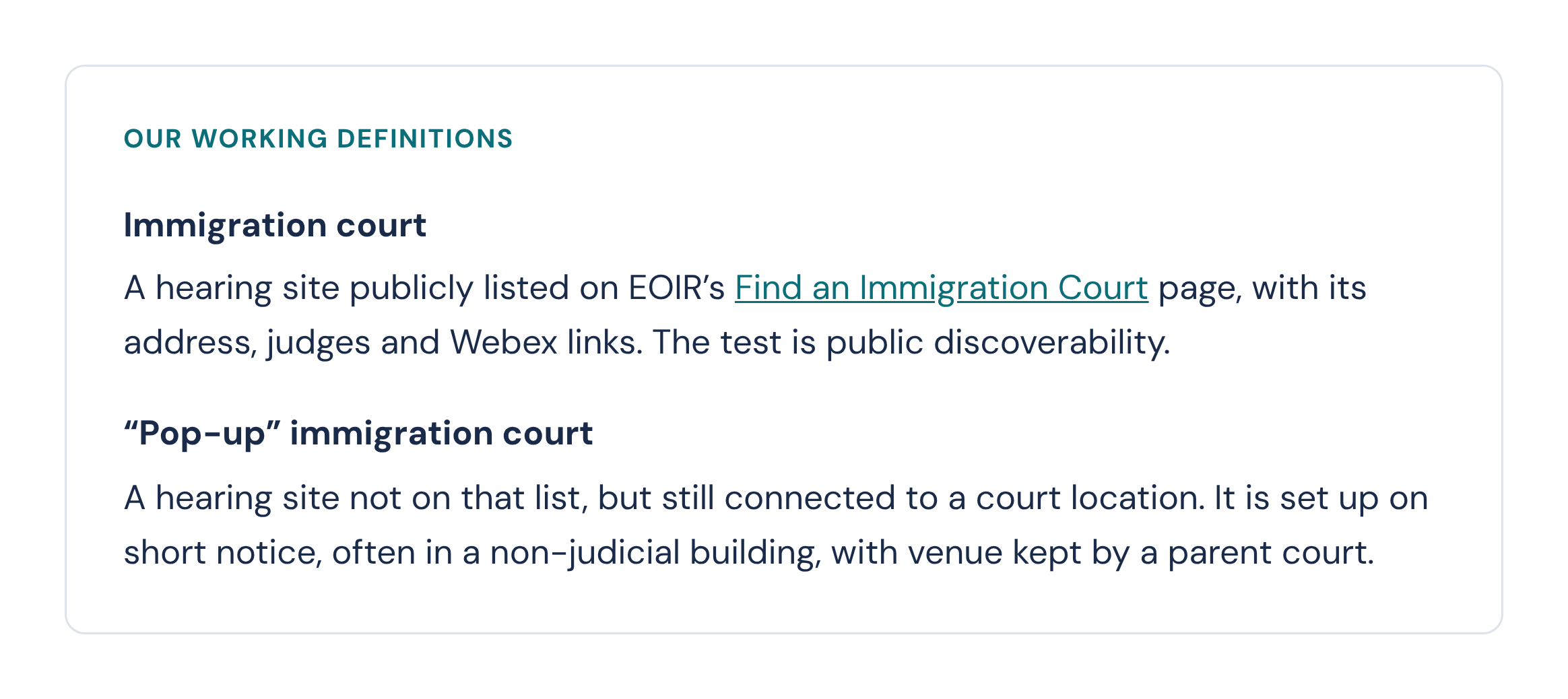
Courts in Questionable Locations
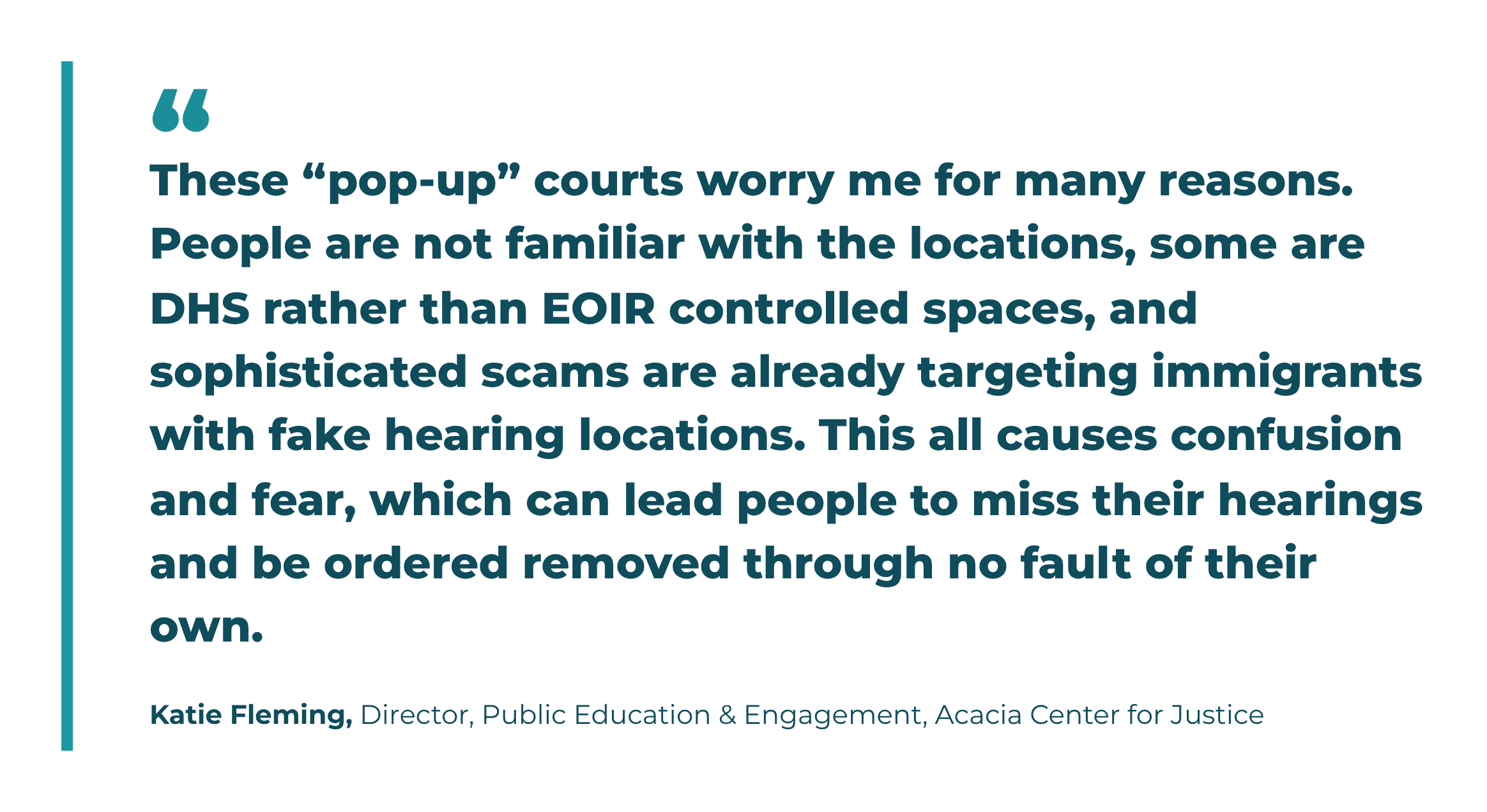
Through meetings with immigration reporters, nonprofits, and court observation programs, we’ve learned that many new hearing sites are opening in places immigrants are allegedly afraid to go, such as FEMA headquarters in Washington, D.C. and EOIR headquarters in Falls Church, Virginia.
NPR has described these sites as “hidden tribunals,” and reported that their unusual locations raise due process concerns. Bloomberg Law reports that DHS is expanding “pop-up” immigration courts while blocking public access. When a hearing site is unlisted, people can’t easily verify where to appear, and observers can’t monitor what happens inside. As the image below shows, some of these sites are so difficult to locate that advocates have had to create their own directions just to help people arrive on time.
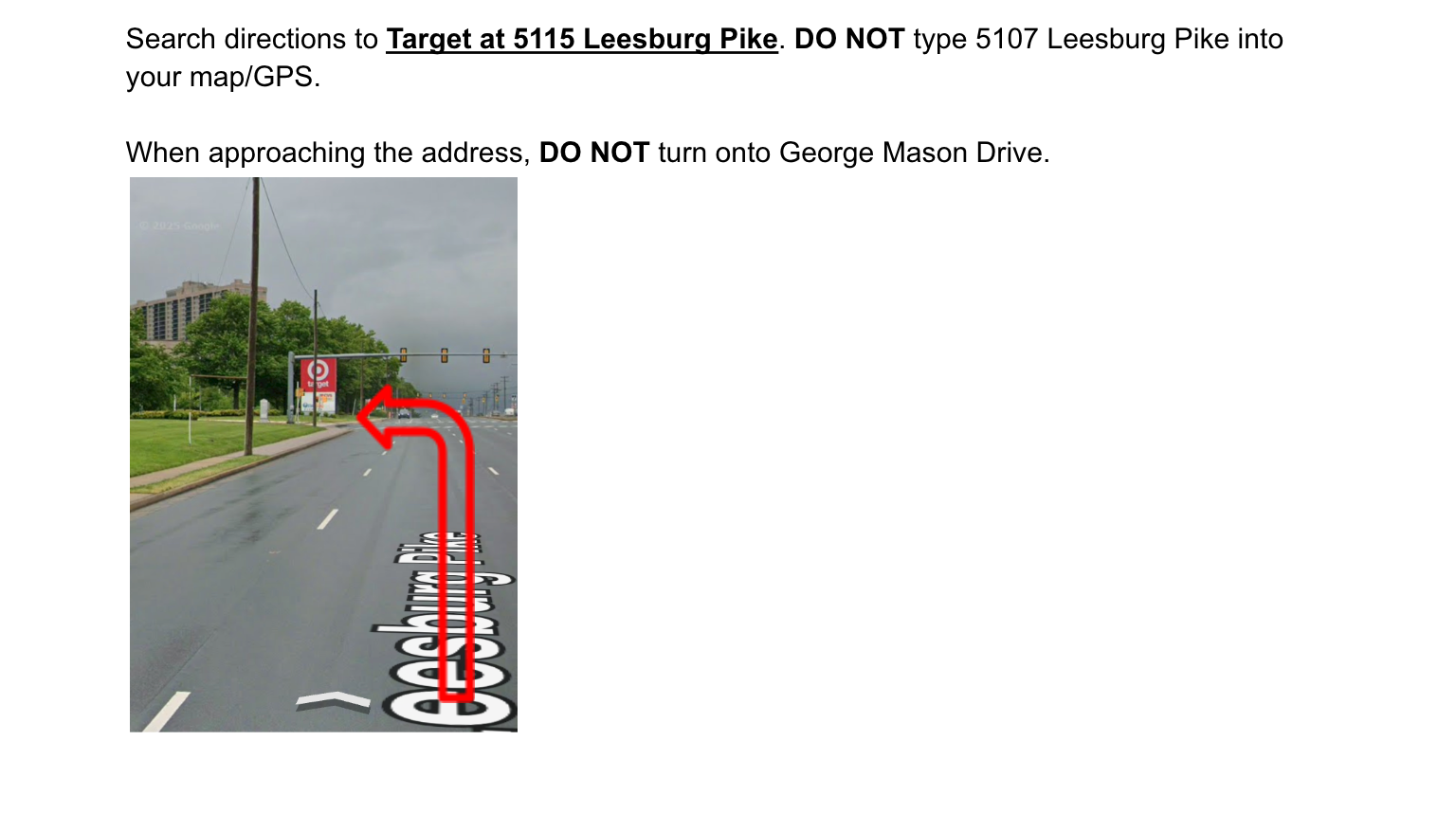
Legal aid workers are racing to share guides like the one shown above, since immigrants are being forced to scramble to find these “pop-up courts.” They are struggling to inform the large population affected.
Outcomes: A First Look
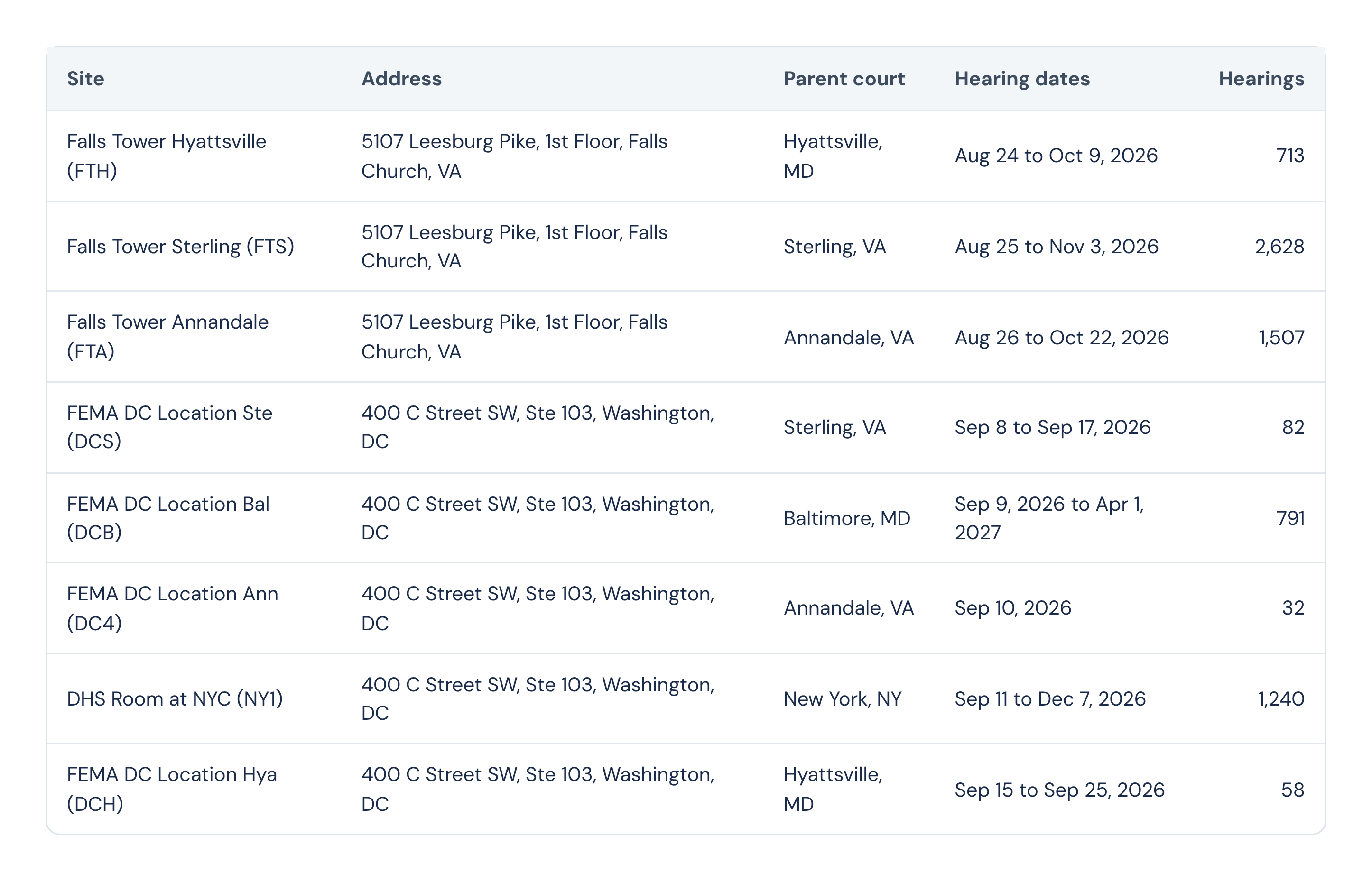
After meetings with former immigration judge Elizabeth Young, who has extensive experience with EOIR and its data, as well as the Acacia Center for Justice, court observation programs, and other organizations, Mobile Pathways has identified eight sites as “pop-up” immigration courts, listed below. Our media and nonprofit partners have described these sites the same way. We analyzed 7,051 hearings across 6,130 cases at these locations, including 1,109 completed proceedings with a final outcome. These are preliminary, early results from analysis conducted by Camila Feltrin, Senior Research Analyst, and Elizabeth Young, Senior Advisor and former immigration judge, and we will refine them as more data comes in and our partners weigh in.
Here’s what we see so far:
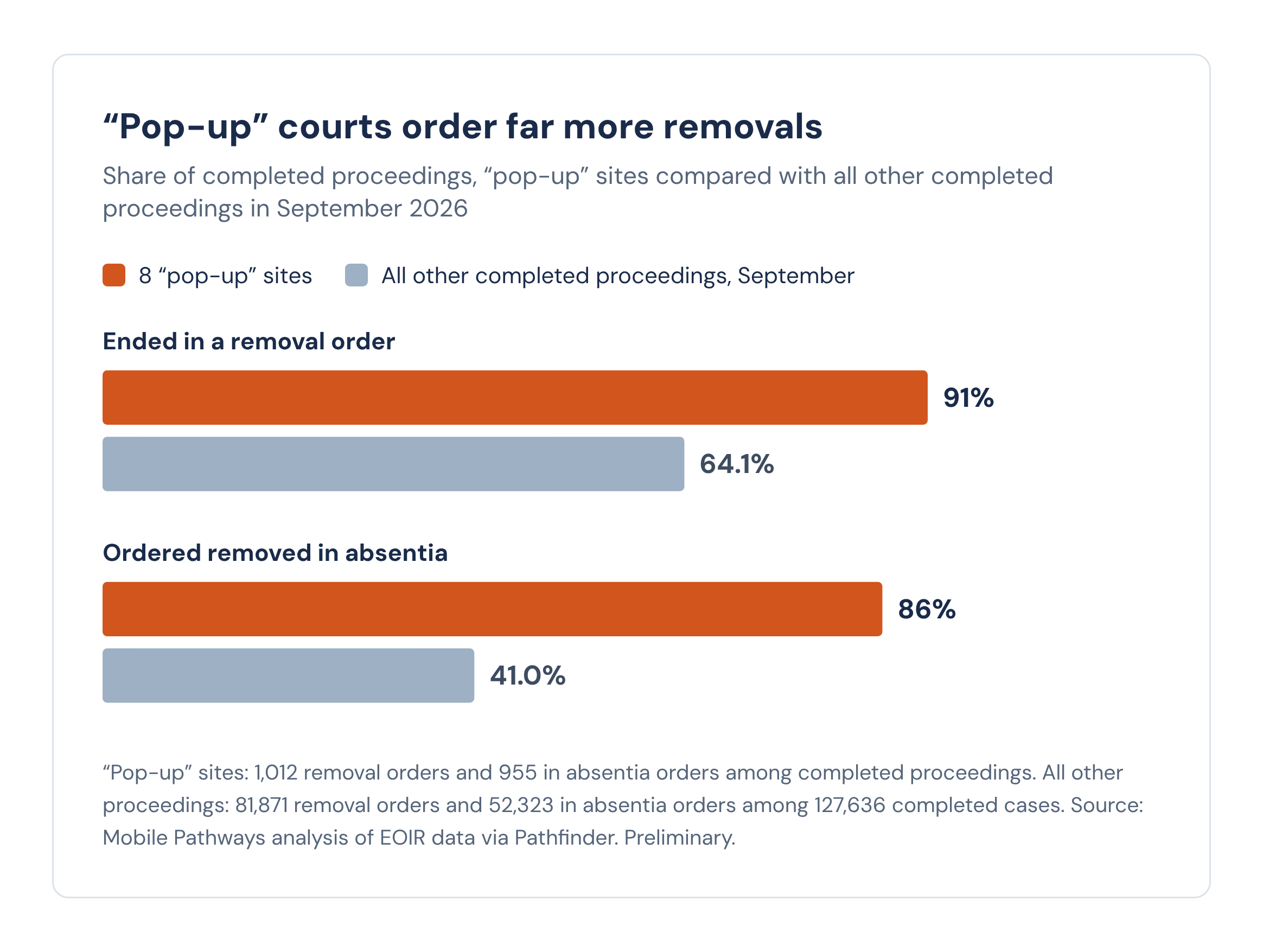
- Removal orders: 91% of completed proceedings ended in a removal order (1,012 cases). 86% were ordered removed in absentia (955 cases), meaning the person wasn’t there.
- No lawyer: 84% of cases were unrepresented, rising to 91% at Sterling-FTS and 87% at NY1.
- Short notice: People got an average of just 13.5 days’ notice, ranging from 9 days at DC4 to 22.5 days at DCS.
- Asylum: Zero grants across 528 asylum proceedings. 85% were deemed abandoned (447) and 13% denied (67). Falls Tower Annandale alone accounts for 204 abandonments, 97% of its asylum cases, with no merits hearings.
- Speed over substance: 99.7% of hearings (7,032 of 7,051) were master calendar hearings. Only 19 were individual merits hearings.
- Concentration: The three Falls Tower sites account for 69% of all hearings (4,848).
If courts can appear anywhere, without public notice, the question “What is an immigration court?” isn’t academic. The question decides who gets a day in court at all. This is especially pertinent as immigrants now face a wave of fake immigration hearing notices sent as scams. As this fake bond hearing notice shows, these scams are highly sophisticated, making it very difficult for immigrants to tell a real hearing notice from a fraudulent one.
With all of this in mind, what does the data show from the initial outcomes of these “pop-up” courts? The numbers speak for themselves. In 86% of completed cases, people were ordered deported without being in the room.
Across 528 asylum proceedings, not one was granted. Most people had no lawyer, and many had less than two weeks’ notice to find a building that appears on no public list. These are early findings, and we will keep testing them. But they raise serious questions about whether these sites can offer the basic fairness every court owes the people who come before it.
We began by asking whether these new sites were opening new avenues for justice or for deportation. As the data indicates, these are clearly not new avenues for justice, they are new avenues for fast-tracking the deportation of immigrants.
Sources
- Ximena Bustillo, NPR, “‘Hidden tribunals’: Immigration court due process in tumult with new locations,” September 4, 2026.
- NPR, Morning Edition, “Immigration court’s unusual locations raise due process concerns,” September 10, 2026.
- Bloomberg Law, “DHS Expands Pop-Up Immigration Courts, Blocking Public Access,” 2026.
- EOIR, Find an Immigration Court and Access Internet-Based Hearings.
- EOIR, Public Access to EOIR Hearings, July 15, 2026.
- Acacia Center for Justice, “Why Public Access to Immigration Courts Matters More Than Ever.”


