
.png)

The latest development in a broader squeeze on asylum: the mega master hearing. People expecting a hearing sometime in the next few years are instead getting a notice for next month: a quick, procedural check-in where a name gets called and next steps get set. Miss it, though, and a person can be ordered removed without a hearing on the actual case ever taking place at all. And that's just the people who found out in time to show up at all — or who had the resources to figure out where to be and come prepared.
We first wrote about this trend a month ago, when court observers had already begun raising the alarm, but the data hadn't yet caught up to show how big this had actually gotten. It has now. The surge of the mega master hearing: one judge, one long sitting, and dozens if not hundreds of people with a huge risk of losing their asylum application.
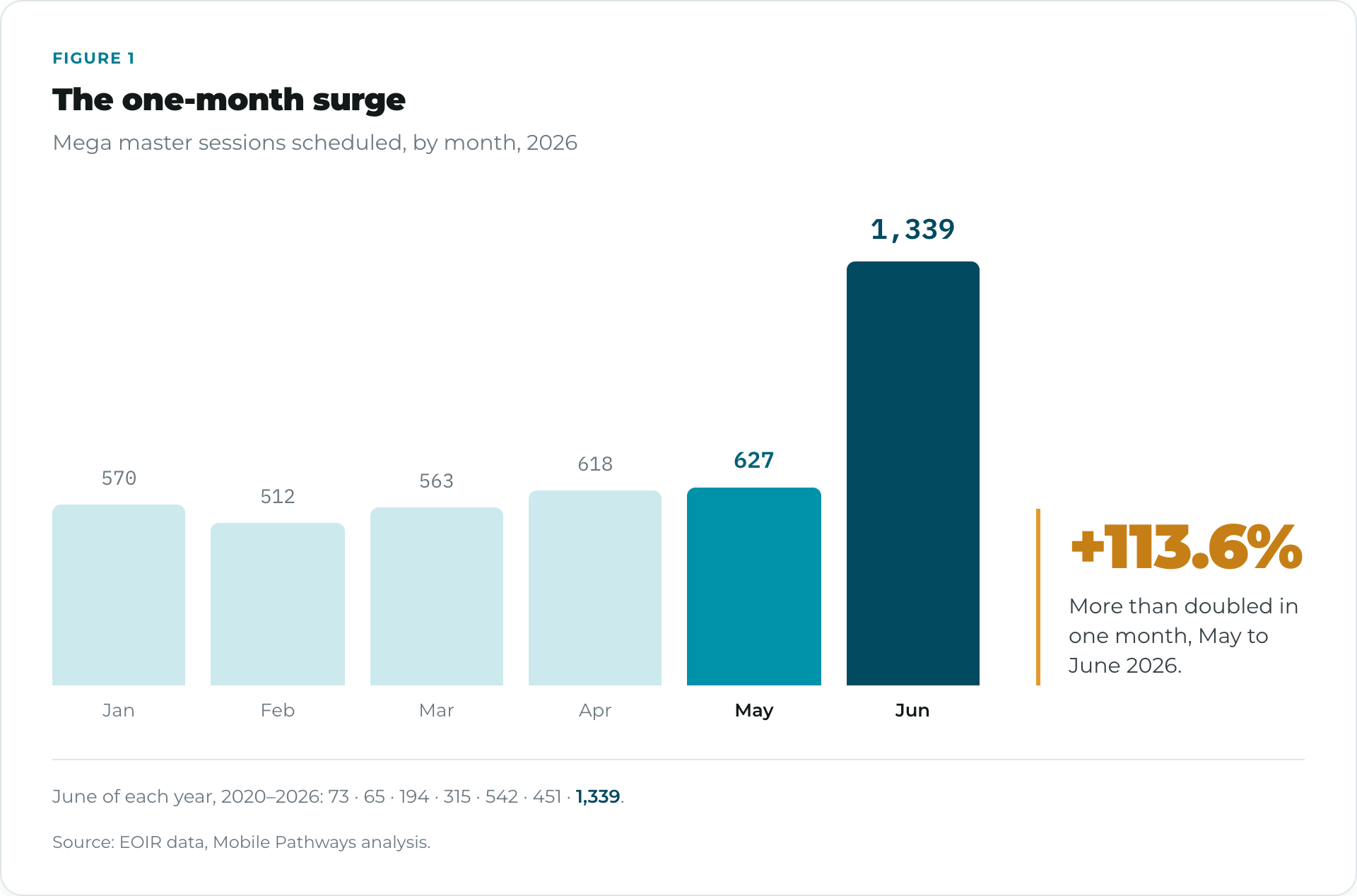
While these hearings weren't unheard of before, they held at a fairly steady pace for months, then spiked at an alarming rate in June: 1,339 scheduled sessions, more than double May's 627. The average session also hit a record, just over 100 people. It isn't only happening more often. Each one is bigger, too.
The Notice Gets Shorter
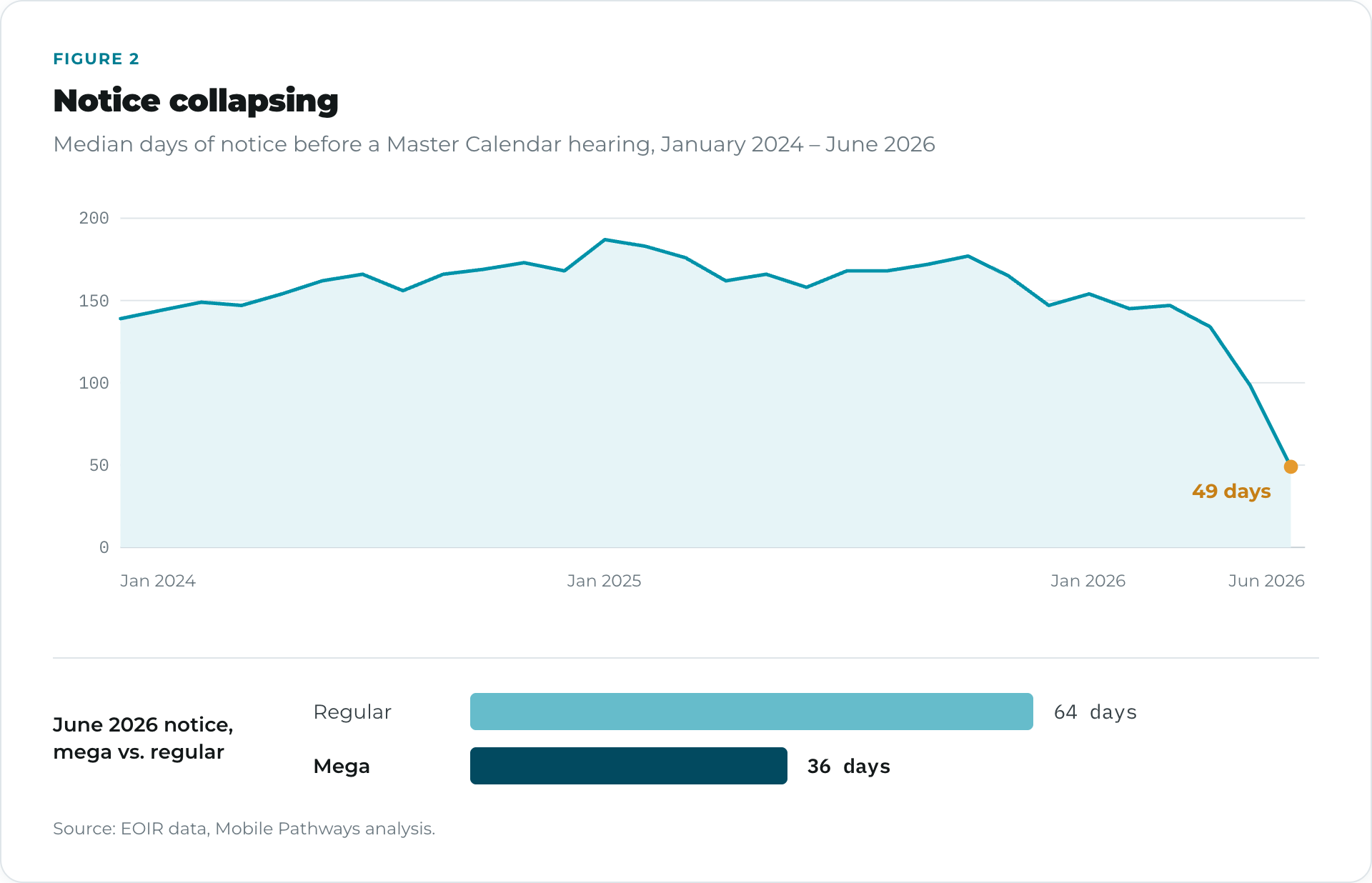
System-wide, the typical warning before any Master Calendar hearing has been shrinking all year, from around 150 days at the start of 2026 down to under 50 by mid-year. Mega sessions show the sharpest version of that same slide: 36 days' typical notice, against 64 for a regular hearing. Roughly half the warning, for the hearings with the most people and the least room for error.
For someone without a lawyer, that notice arrives one way: a letter in the mail. The letter itself takes time to arrive before the clock on preparing even starts. Half the warning doesn't mean half the paperwork. It means the same paperwork, in half the time.
The Lawyers Disappear
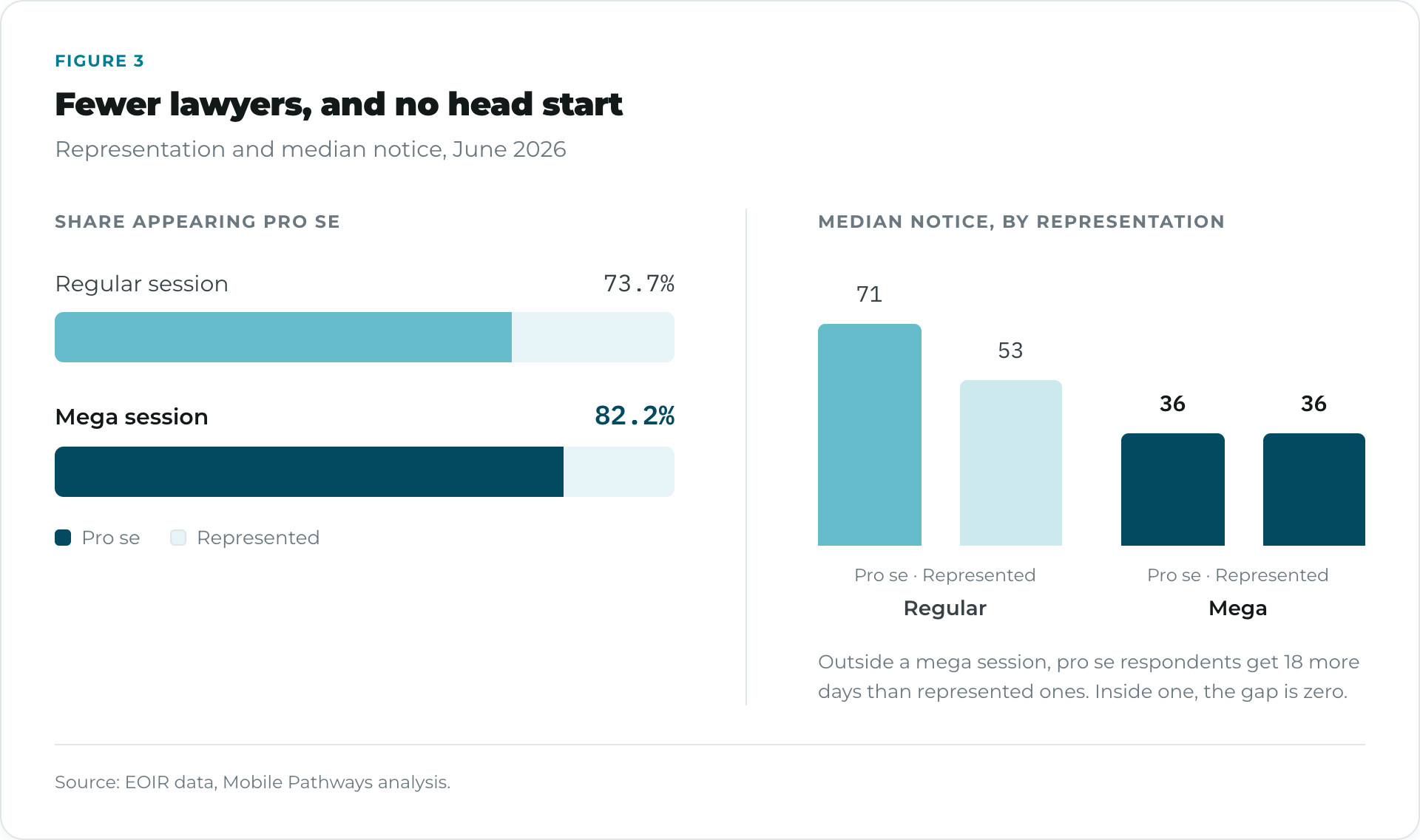
Only about 23% of people at a Master Calendar hearing in June had a lawyer on record. In a mega session, that drops further still: 17.8% represented, 82.2% pro se, against 26.3% and 73.7% in a regular hearing.
Here's the part that doesn't run the direction you'd expect. In a regular hearing, people without a lawyer actually get more typical notice than people with one, 71 days versus 53. Something in how these cases move through the system tends to favor the pro se respondent with a longer runway, at least outside a mega session. Step into a mega session, though, and that gap disappears entirely: represented and pro se alike get the same 36 days, flat. Whatever cushion existed for the person without a lawyer gets erased the moment the docket gets crowded enough.
The Missed Hearing Becomes Two Losses
Two different things can happen to someone who doesn't show up to court. A judge can order them removed in absentia, simply for not being in the room. Separately, if that person has an asylum application on file, the law treats a missed hearing as a decision to walk away from that claim too, no separate statement required. One absence, two losses, and most people in this position never had it explained to them that way.
In mega sessions, 67.9% of decided cases end in absentia, against 44.8% in regular sessions, a 23-point gap. Run that same comparison on asylum claims specifically, and abandonment climbs to 76.4% in mega sessions against 61.3% in regular ones.
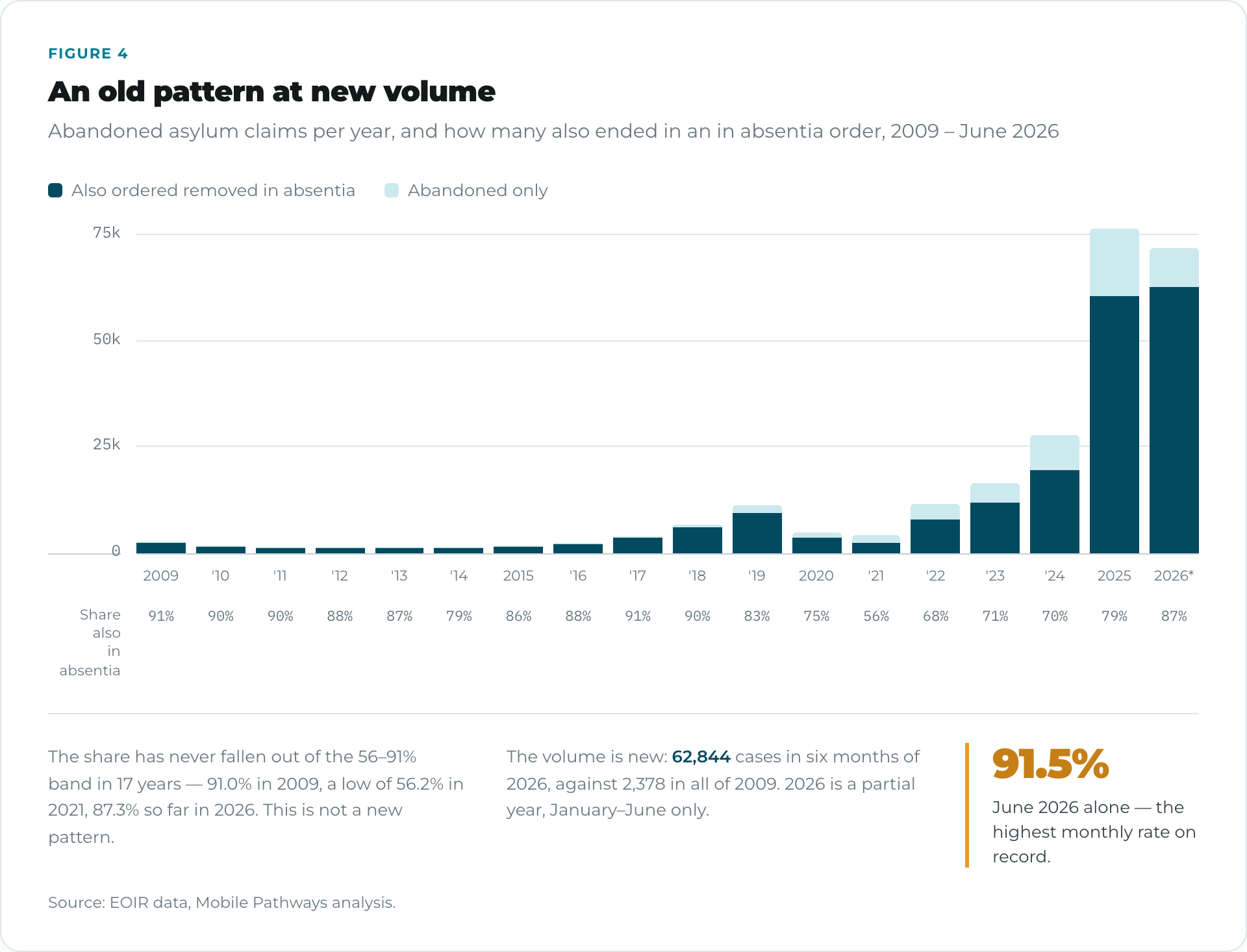
These aren't two separate trends, and the link between them isn't new. Going back to 2009, most abandoned asylum claims have also ended in an in absentia order — the two have travelled closely together every year on record. What's new is the volume. In 2009, that pattern described 2,378 cases in a year. In the first six months of 2026 alone, it describes 62,844, more than any full prior year on record. June alone hit 91.5%, the highest monthly rate in nearly 8 years.
Court watchers and legal advocates who monitor these hearings in person, including volunteers at Acacia, describe a related confusion, not about missing a hearing, but about what happens at one you did attend: respondents leaving the courtroom unsure what had just happened to their case, told only that their application was "incomplete," without being told what was missing or how to fix it before the next deadline.
What That Adds Up To
Put it together, and in a mega session, 69% of people never get a real hearing at all, ordered removed for missing court, or their claim dropped as abandoned. In a regular session, it's 46%.

Zoom out further, past mega sessions specifically, and the same math shows up system-wide. In June 2026, of everyone with a pending asylum application, just over half, 50.4%, were ordered removed in absentia without ever appearing. Narrow that to Master Calendar hearings alone and it barely moves, 50.8%. For someone with an asylum claim in the system today, whether their case ends in a real hearing or an empty chair is close to a coin flip.

The Slow Climb, Then the Jump
None of this started this year. In June 2014, 1 in 24 people scheduled for court was ordered removed for not appearing. By June 2023, it was 1 in 14. By June 2026, 1 in 6.5.

The climb hasn't landed evenly. New York's abandonment rate now runs more than six times its own historical average, the sharpest jump of any city tracked. Harlingen holds the record on the other measure: its in absentia rate has more than doubled relative to its own history, the steepest climb of any city tracked. Same country, same policy environment, different cities driving each part of the surge.
July ended with New York as the clear leader in mega sessions, and Atlanta tying New York for the largest average number of people packed into a single session.
The map keeps shifting. Early scheduling for August shows the pattern growing, with cities like Charlotte and Boston climbing into the top ranks too. Both figures come with the usual caveat: July's outcome data isn't confirmed yet, and August's schedule, already a couple of weeks stale, is likely to shift before the month arrives.
The Youngest in the Room
Kids aren't the reason mega sessions exist. Nationally, juveniles make up a smaller share of mega-session respondents than their roughly 4.7% share of the system overall, consistently below that baseline every month on record (2.53% in June 2026). But look closer, at unaccompanied minors specifically, kids with no parent or guardian on their case, and the pattern reverses: they make up a majority, 53%, of the juveniles inside mega sessions, more than the 49% they represent in regular ones. And when a juvenile's case is decided in a mega session, six in ten still end in absentia, a smaller gap than adults face, but a real one. The kids least likely to have anyone with them are, disproportionately, the ones ending up in the room built for a hundred.

For more on methodology, please check out our blog post Mega Masters: Tracking a System Under Strain.


