


The American immigration system is currently navigating a period of profound structural transformation. One year into the administration’s accelerated deportation and detention framework, the data reveals a system where traditional legal pathways are not simply narrowing: they are being structurally dismantled. As we track this shift, three distinct trends have converged to create a constitutional flashpoint in our federal court system.
Pushing the Limits of Mass Detention
.png)
We are currently witnessing the largest detention expansion in modern history. ICE’s detainee population has reached a staggering new record high of 68,289 individuals. This represents a near-doubling of the population in just twelve months. This surge is not merely a statistical anomaly; it is the result of a deliberate policy shift toward mass incarceration as a primary tool of immigration enforcement.
A Slow Death of the Bond Hearing
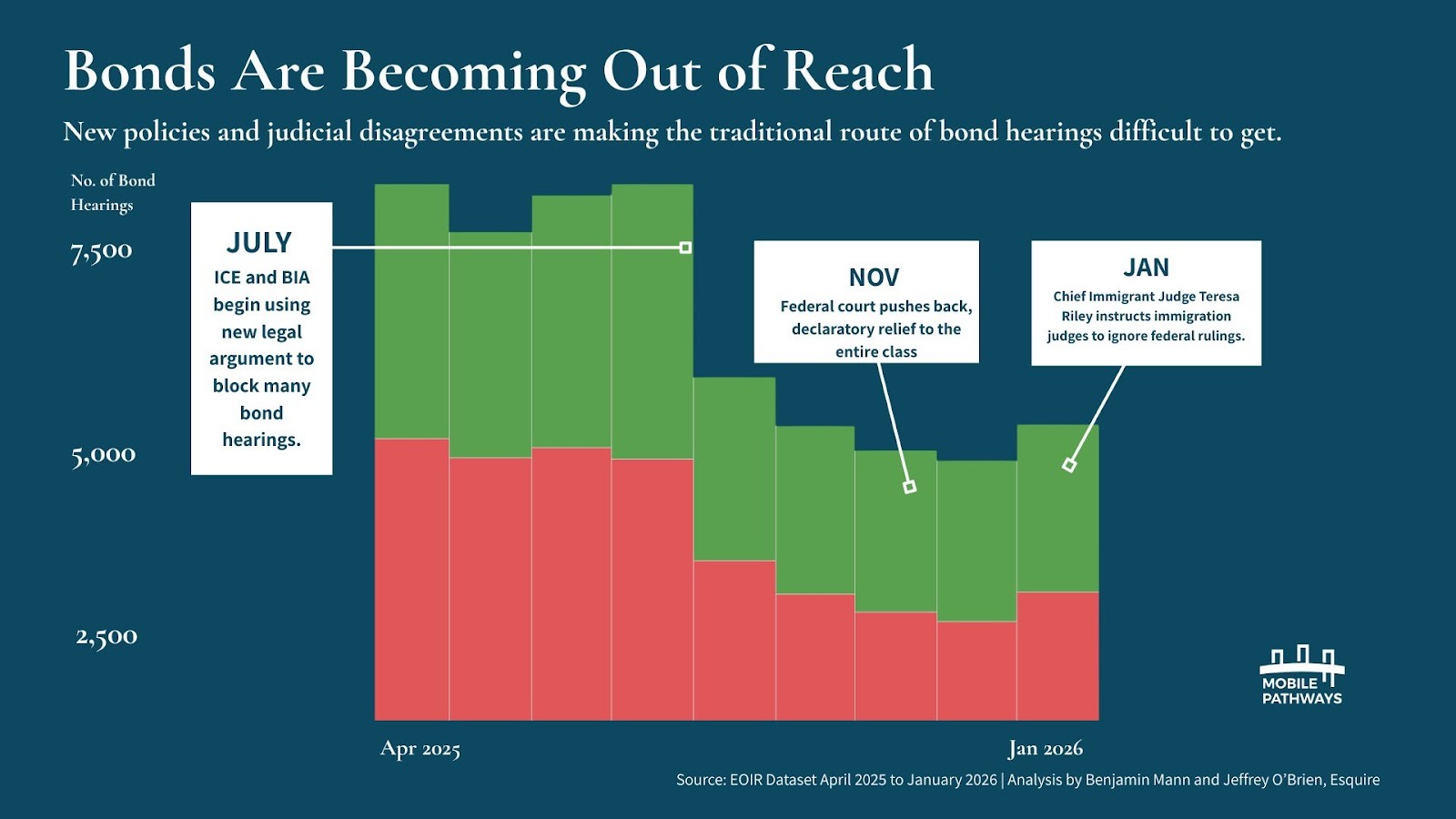
Historically, the immigration bond hearing served as the primary mechanism for due process, allowing individuals to argue for their release while awaiting trial. However, following a July 2025 policy shift, the Executive Office for Immigration Review (EOIR) and the Board of Immigration Appeals (BIA) began utilizing new legal arguments specifically designed to block these hearings for an ever growing number of immigrants.
The result has been a "bond bottleneck". As traditional bond success rates have cratered, the administrative path to liberty has been effectively stymied. In January 2026, instructions were even issued for immigration judges to ignore certain federal rulings that attempted to push back against these restrictions.
According to reporting by Thomson Reuters, Chief Immigration Judge Teresa Riley issued an internal directive instructing immigration judges that they are not bound by federal court orders—specifically a nationwide ruling by the U.S. District Judge Sunshine Sykes—which declared the administration’s mandatory detention policy unlawful. Riley argued that because the court issued a "declaratory judgment" rather than an injunction, the administration’s restrictive BIA precedents remained "binding" on all judges.
This directive has created a brewing constitutional crisis where the agency is essentially instructing its employees to disregard the federal judiciary to maintain the blockade on bond hearings.
The Habeas Explosion
.jpg)
Habeas Corpus is the legal equivalent of a "break glass in case of emergency" hammer; a method to bypass injustice by taking the complaint directly to a federal judge to ask: "By what legal right is this person being held?"
As administrative doors to bond hearings are bolted shut, the battle is shifting to the federal docket at a breathtaking pace. While filing a habeas petition is administratively complex and requires precise timing, immigration advocates have refined these processes to a fine art, turning a difficult legal hurdle into a vital necessity for those trapped in the system.
The outcomes are staggering: habeas petitions have spiked by 483% since 2020, as shown above. In just the first two months of 2026, filings hit 7,875, almost the full 2025 total of 8,101. This is not a plateau. It is an acceleration, and 2026 is projected to dwarf 2025.
This strategy has become the primary line of defense for one simple reason: it works. While administrative courts remain stalled, federal judges have ruled in favor of immigrants in roughly 97% of cases, frequently ordering immediate releases or forcing the government to provide the very hearings it sought to eliminate.
The Breaking Point Nears
This volume of litigation is unsustainable, no market can withstand that growth without some sort of correction or crash. We are observing a system under such extreme strain that a correction, or a confrontation, is inevitable. As former Immigration Judge Jeremiah Johnson notes:
"The appellate courts will inevitably be compelled to weigh in on this jurisdictional shift, particularly as these filings concentrate within federal districts where new, large-scale detention facilities are being established. We are likely approaching a definitive moment of judicial or legislative reckoning."
What we are learning now is that this surge is not evenly distributed. It is clustering in a small set of federal districts that sit closest to the largest detention footprints, where immigration custody is densest and the bond pipeline is most constrained. As those districts absorb a disproportionate share of filings, early divergence is emerging in how judges are handling the same core questions, including jurisdiction, standards for review, and the practical limits of detention without a meaningful bond process.
That kind of fragmentation is how a national rule gets forced. It is the classic setup for appellate conflict and, ultimately, Supreme Court review.
Increasingly, we are hearing from experts and observers that this strain on the federal habeas system will invite either a Supreme Court showdown or an aggressive legislative push to eliminate habeas access for immigrants. Such a move would be an attempt to permanently seal what has become the last effective legal pathway to liberty.
The data is clear: the current enforcement strategy has created a legal pressure cooker. Between record detention and blocked bonds, the federal courts are currently the only thing preventing a total collapse of due process.
The question now is how much more weight the "Great Writ" can carry before the system reaches its ultimate breaking point.
Data Credits: Analysis by Bartlomiej Skorupa, Benjamin Mann, Camila Feltrin, Honorable Jeremiah Johnson, and Jeffrey O’Brien, Esq.
Source data provided by the Asylum Navigator, EOIR, ICE, and the Habeas Docket.


