

Last month, Mobile Pathways showed how habeas corpus, the ancient legal right to demand your freedom, had become immigration's last line of defense. Federal courts were the only thing keeping due process alive as the administration blocked bond hearings at scale.
The data since then tells a darker story.
Bond hearings have hit a record low. In March 2026, just 326 immigrants were released on bond, down from over 2,400 a month a year ago. That's not a dip. That's a collapse.
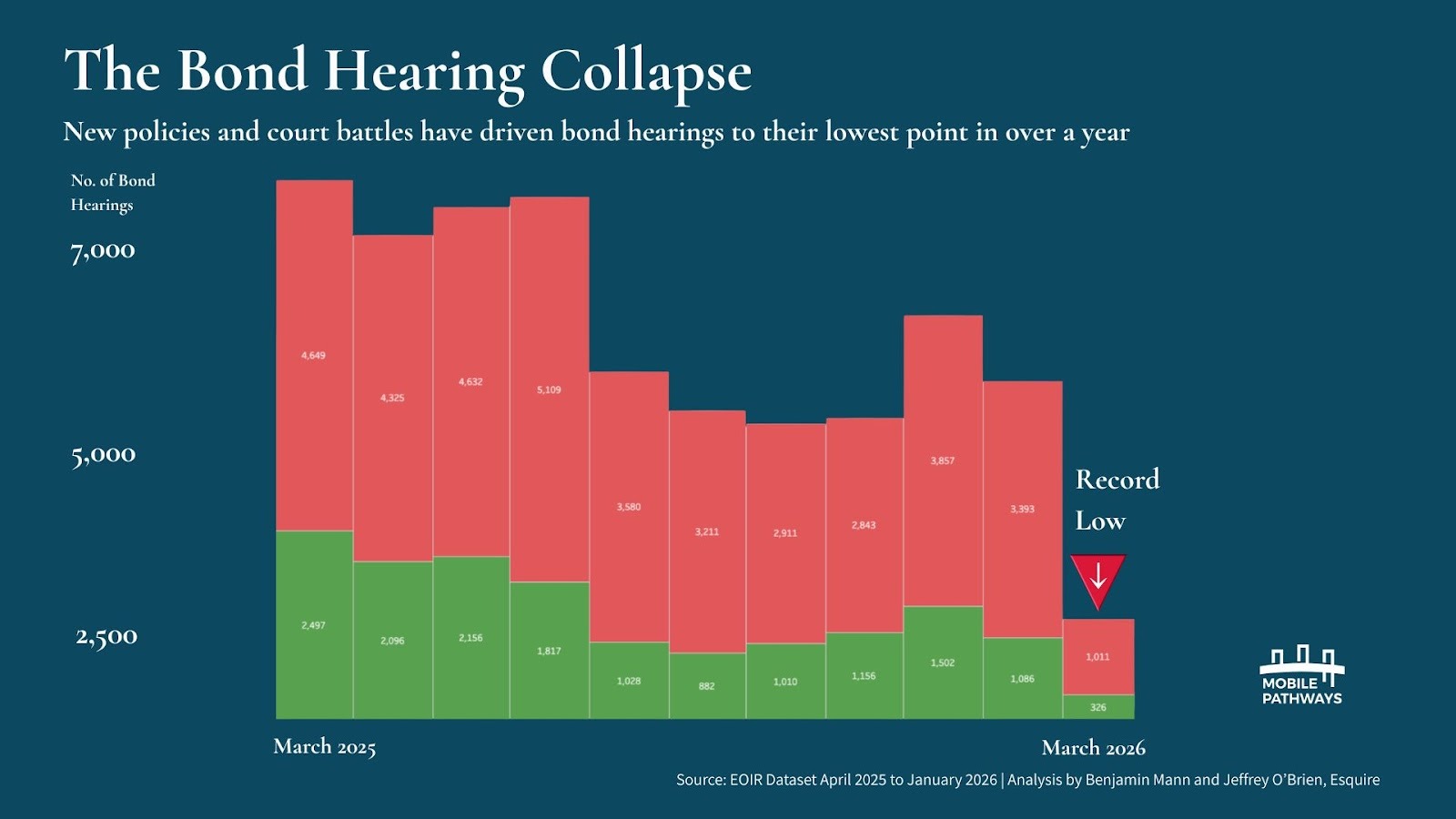
Two forces appear to be driving it. The first is a January directive from the country's top immigration judge, instructing judges across the country to keep denying bond hearings even when federal courts were ordering otherwise. The second is the February 6th appeals court ruling covering Texas and Louisiana, which legally foreclosed bond hearings for most detained immigrants in those states entirely.
As former Immigration Judge Jeremiah Johnson observes, immigration judges in those states stopped scheduling bond hearings almost immediately after:
"When the circuits speak in different voices on a question this fundamental, the government's authority to detain and the individual's right to be heard, the law does not rest easy for long. History suggests that the courts will find a way to be heard on the matter."
When the judges running the hearings are told not to hold them, and the courts that would otherwise intervene are now bound by a ruling that says they can't, the number of people reaching a judge to argue for their freedom collapses. Whether by design or by convergence, the effect is the same: the bond hearing, once the system's primary check on indefinite detention, has been effectively dismantled in the states where most people are locked up.
Meanwhile, habeas filings keep climbing
Mobile Pathways' new national map shows tens of thousands of petitions filed across the country, concentrated in the districts nearest to the largest detention centers. Immigrants and their lawyers have turned this obscure legal mechanism into a lifeline, filing at a pace that is overwhelming federal courts.
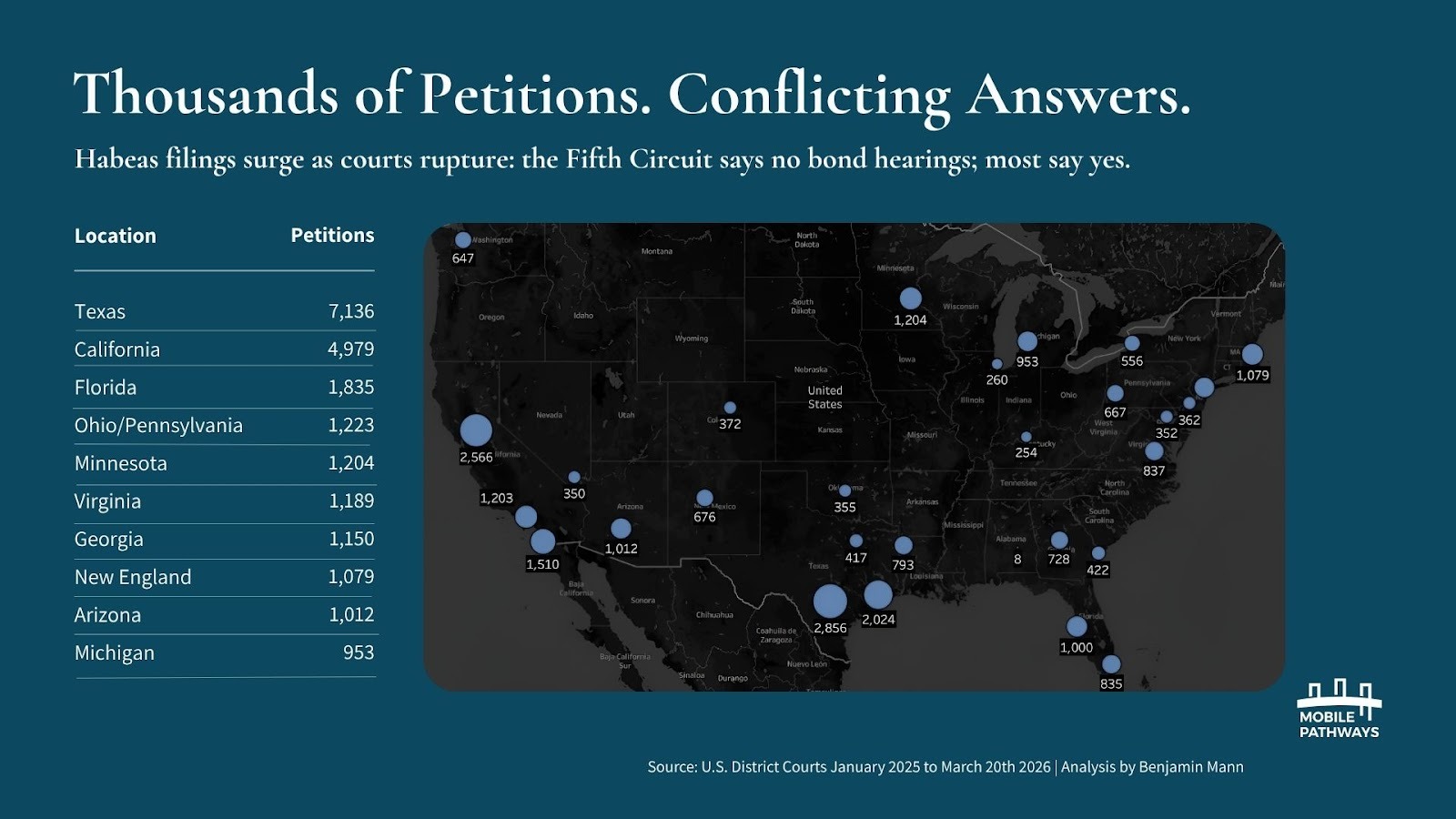
Note: Locations are approximate and do not identify specific federal judicial districts or courts of filing. Jurisdictional boundaries may differ from geographic designations shown. For informational purposes only.
But courts are starting to disagree on the answer. The appeals court in Texas says no bond hearings. The appeals court in Chicago says yes. Most federal judges around the country have sided with immigrants, but the Texas ruling covers the states where most people are actually locked up. Lawyers are now racing to file petitions before their clients are transferred into Texas jurisdiction, because where a case is filed determines whether there is any meaningful chance of release.
That kind of contradiction doesn't hold. It forces a national resolution.
This Ends at the Supreme Court
When it gets there, the justices will decide a simple but profound question: can the government detain someone who has lived in this country for decades, without ever letting a judge decide if they should go free?
Mobile Pathways will track every step of that fight.
Data Credits: Analysis by Bartlomiej Skorupa, Benjamin Mann, Camila Feltrin, Honorable Jeremiah Johnson, and Jeffrey O'Brien, Esq. Source data from EOIR, and U.S. District Courts.


