
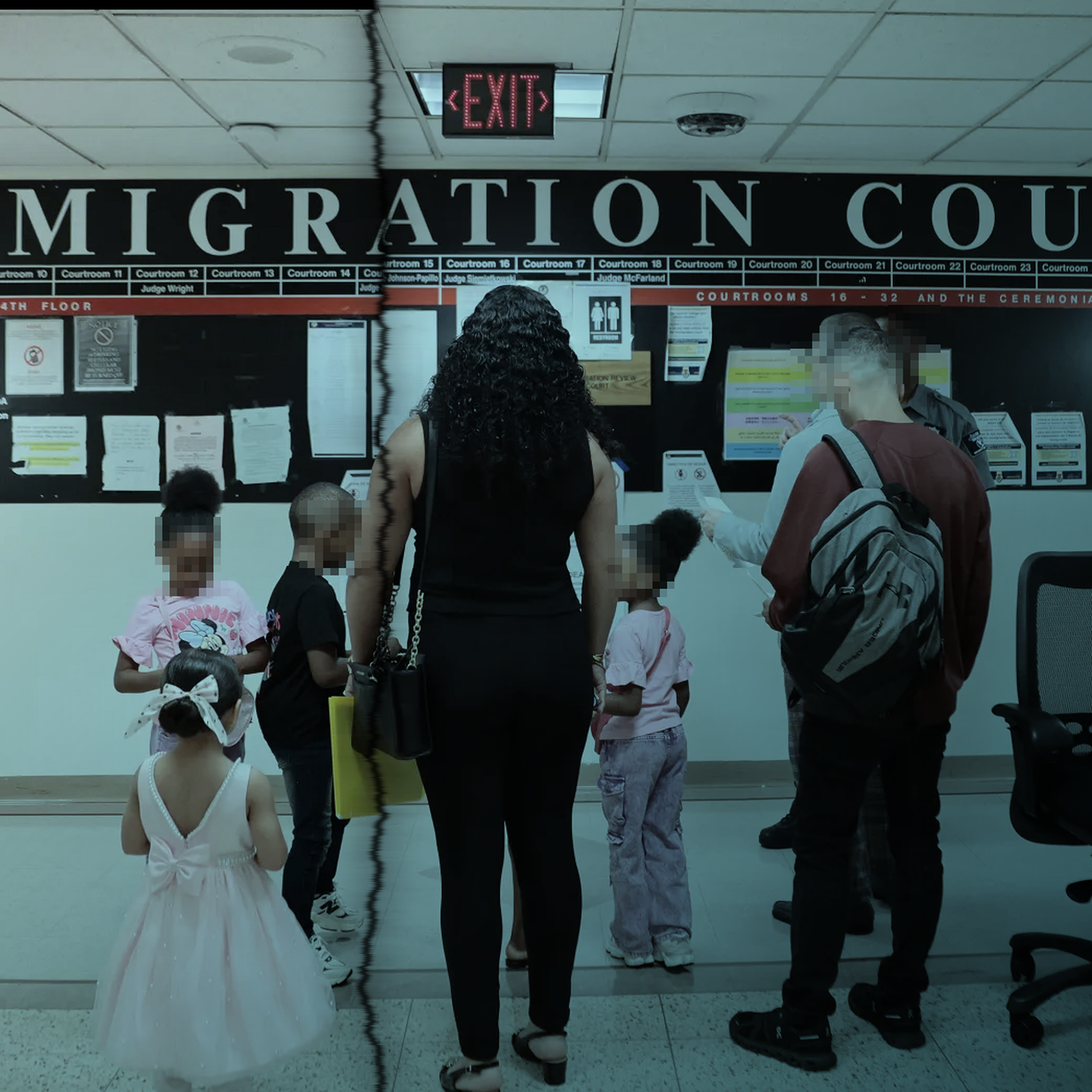

At the end of August, a 16-year-old named Noé traveled more than an hour from his home in Rhode Island to an immigration court in Chelmsford, Massachusetts. He had done everything he was supposed to do. He showed up with his lawyer. A state court had already found that he had been abused, neglected, and abandoned by his mother, and his application for Special Immigrant Juvenile Status was pending. For decades, that would have been enough to pause his case. Instead, after a brief hearing in early September, the judge said she could not delay it, and ordered him deported. Moments later, Noé called his father in tears, afraid ICE agents were waiting outside. “They’re going to arrest me,” he said.
Noé was not the youngest. Over a single month, the same judge ordered 17 children deported, among them 7-year-old twin boys from Colombia, in hearings that often lasted only a few minutes. Earlier this year, the Board of Immigration Appeals ruled that judges should not delay a child’s deportation case while the child seeks humanitarian protection, even though that protection is decided on a separate and much slower track. The result is a system that can order a child removed before the government finishes deciding whether that child qualifies to stay.
Mobile Pathways is proud to partner with the Oakland and San Francisco Unified School Districts and ImmSchools at a moment when stories like Noé’s are no longer exceptions. Through this partnership, both districts have access to Pathfinder AIDE, which sends instant alerts whenever anything changes in an immigrant student’s case. We are seeing a wave of data showing children targeted by this administration at a speed and scale that should alarm anyone who believes a child deserves a fair day in court. Here is what that data shows.
1. The Sharp Rise
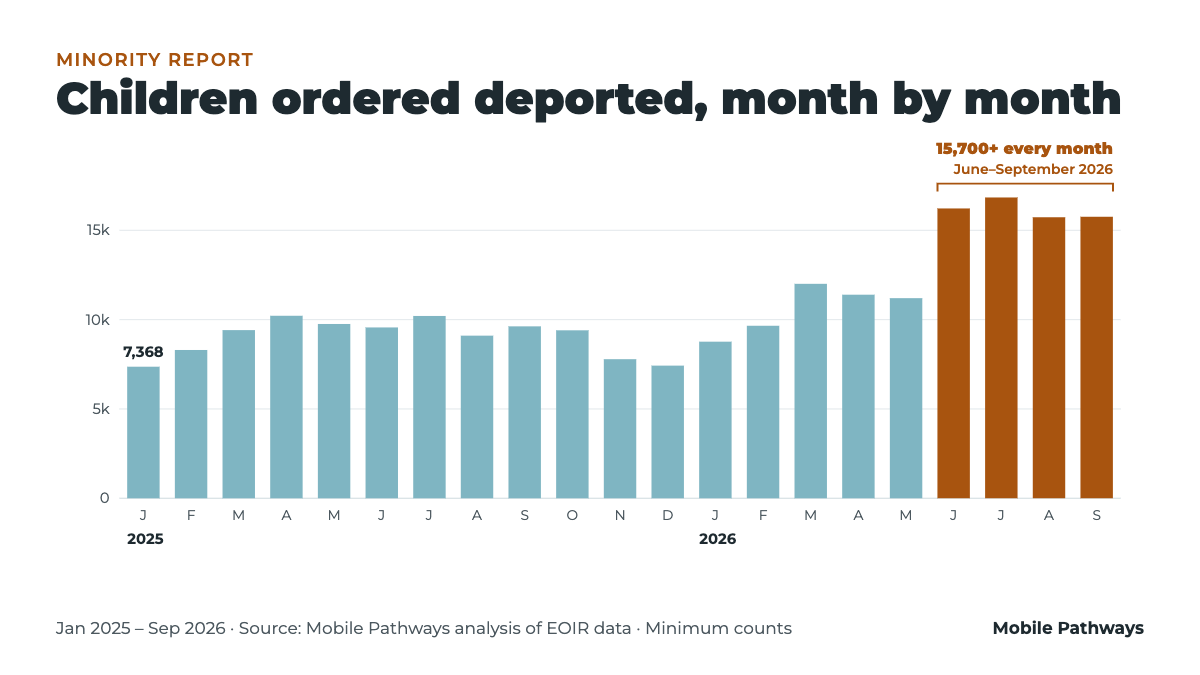
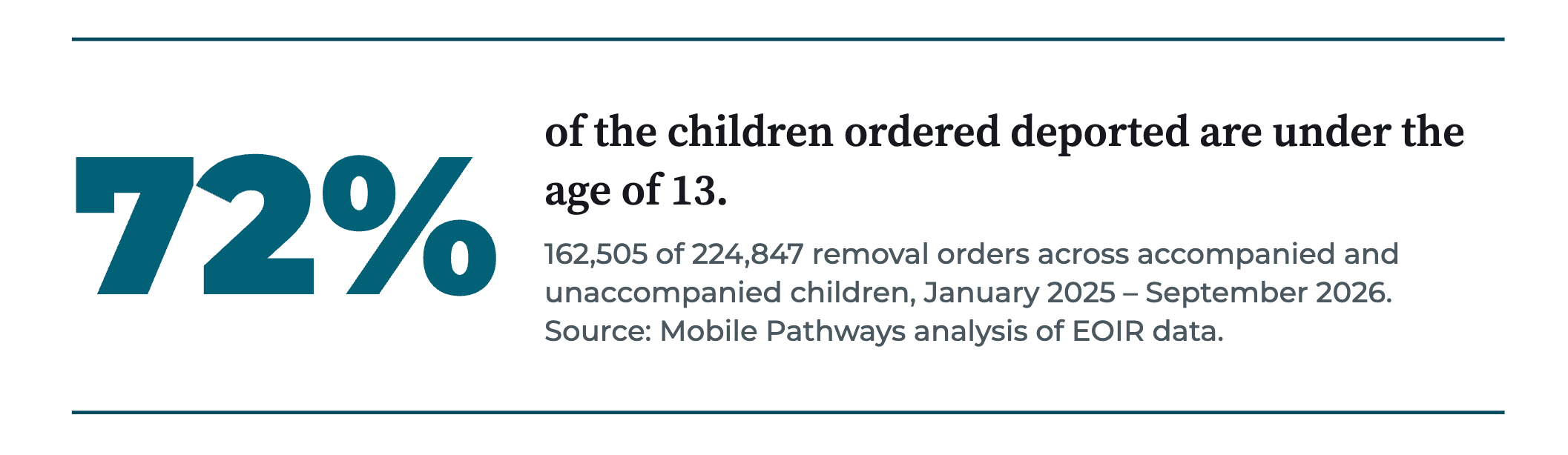
In January 2025, immigration judges ordered 7,368 children deported. By September 2026, the monthly figure was 15,762, more than double. In the first nine months of 2026, 117,575 children were ordered deported, compared with 83,546 over the same months of 2025, an increase of 41%. Across these 21 months, that adds up to 224,847 distinct removal orders.
Even these numbers are a floor. Court records include a usable birth date for only about 84% of decisions, so children whose age cannot be confirmed are left out of every count here.
Not every month rises. Orders dipped late in 2025 and again this spring. But the direction is unmistakable, and in June it broke sharply upward: orders jumped from 11,203 in May to 16,228 in June, a 45% leap in one month and the largest of the period. July set a new high at 16,843, and orders have stayed above 15,700 a month since.
The driver was children who missed court hearings. In absentia orders rose 59% from May to June and made up 86% of the added orders. The jump came alongside a surge in master hearings, the short preliminary hearings that come first in a case, which climbed in April and again in June. These came with shorter notice time, making it harder for respondents to attend, and leading to more "no show" removal orders, in step with reports that the government is push.
This is not a backlog working itself out. It is a policy producing exactly what it was designed to produce.
2. Who Counts as “Unaccompanied”?
Noé’s case shows how hard it is to track these children, and why the official numbers likely understate what is happening.
Noé did not cross the border with a parent. He made the journey from Guatemala with his 13-year-old brother to join their father, who had left five years earlier to work and send money home. That single fact, arriving without a parent or legal guardian, classified him as an unaccompanied minor. When the boys were released to their father in May, they were reunited with family, but Noé’s case stayed on the unaccompanied track. A child who has a parent in the country can be processed as though he has none.
The classification depends on a moment in time. A child counted as unaccompanied at the border may later live with a parent, a sibling, or a sponsor, and immigration court records do not consistently update to show that. Children’s humanitarian protection cases run through a different agency than their deportation cases, so no single dataset follows a child from arrival to outcome.
That gap shapes our own work. The field EOIR uses to identify unaccompanied children can be overwritten as a case moves, and these inconsistencies led TRAC to suspend publication of this data in 2021. Rather than relying on that field alone, our estimates use a method adapted from peer-reviewed research that identifies unaccompanied children by age at arrival, court docket type, and links to an adult’s case. It is the closest measure court data allows, but it still counts some children who have a parent here and cannot see children who were never even summoned to court, so the true number of unaccompanied children remains unknown. More can be found on our methodology here.
What our data can show is how quickly the ground has shifted. Unaccompanied children make up nearly half of all minors in immigration court proceedings. The rate at which judges grant them more time, to find a lawyer, file an application, or wait on a sponsor, fell from nearly 80% at the start of 2025 to 46% in June 2026. Over the same period, orders issued against unaccompanied children who missed a hearing roughly doubled.
3. Fewer Lawyers, Faster Dockets
Unaccompanied children are facing a faster docket with less legal help. Judges are speeding through children’s removal cases, and the federal contract that funded legal providers like Acacia expired at the end of July.
Our data shows how little due process is left. Since January 2025, 97% of removal orders for unaccompanied children were issued at preliminary master hearings, meaning the full case was never heard. And the notice children get before those hearings is shrinking. In March, the typical child had about three and a half months’ notice. By September, it was about seven weeks, and the share of children given less than a month more than doubled, from 17% to 36%.
Amid this fast processing, nearly 22,000 children still have open cases, and only about 1 in 30 has a full hearing on the calendar before December. If the pattern holds, most cases will be decided at the short preliminary hearings, not at a full one.
A lawyer still makes a large difference. This year, children without an attorney were about five times as likely to have their case decided without them present in court, and more than twice as likely to be ordered removed. But the faster docket is reaching represented children too: their removal rate nearly quadrupled from last year.
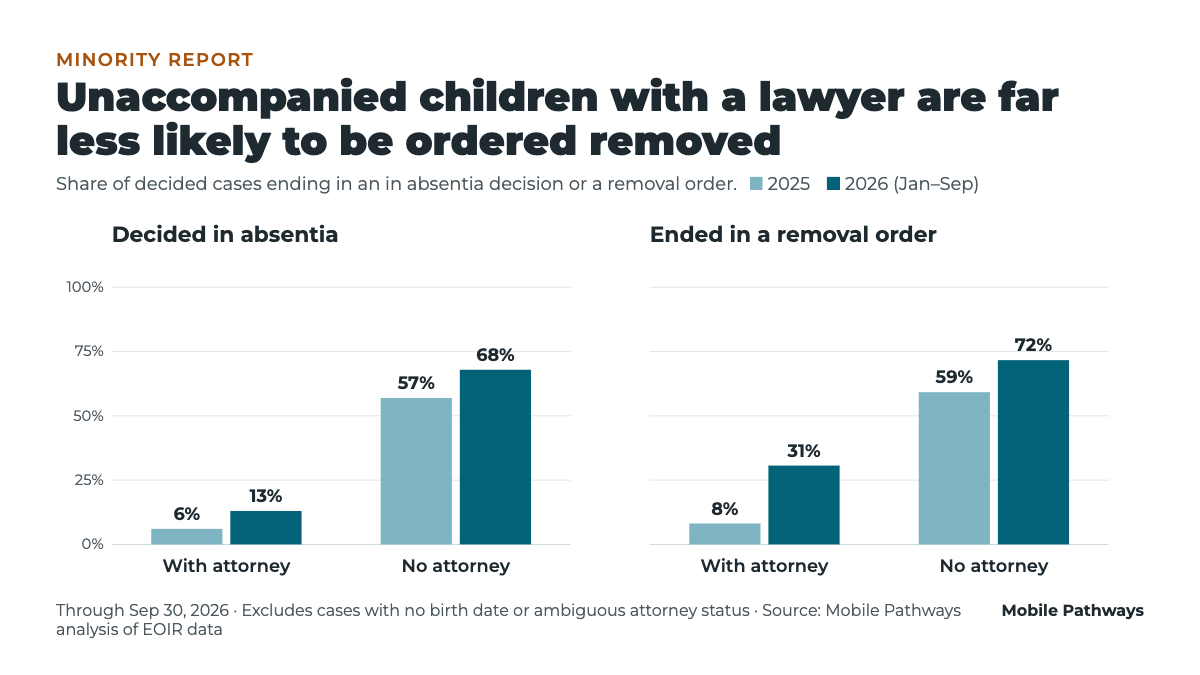
The pattern in the data is clear: faster dockets, thinner notice, and fewer chances to be heard. The next releases will show whether the pace holds as children who lost federally funded lawyers reach court.
Sources
Noé’s story and Chelmsford court observations: The Boston Globe, September 21, 2026.
Continuance and in absentia trends, and judges speeding through children’s cases: Mobile Pathways data, as reported by Bloomberg Law, August 20, 2026.
Government push to process children’s cases faster: The Guardian, September 19, 2026.
Expiration of the federal legal services contract for unaccompanied children: Bloomberg Law, August 4, 2026.
Unreliability of EOIR’s juvenile data: TRAC, “Immigration Court’s Data on Minors Facing Deportation is Too Faulty to Be Trusted”, 2021.
Method for identifying unaccompanied children in court data: Galli, Chiara, and Tatiana Padilla. 2025. “New Data on Unaccompanied Minors in US Immigration Court (2009–2023).” International Migration Review 60(3): 1812–1842. DOI: 10.1177/01979183251316528.
Monthly deportation orders: Mobile Pathways analysis of Executive Office for Immigration Review (EOIR) data, cutoff September 30, 2026.
Methodology for identifying unaccompanied children: Mobile Pathways Methodology & Documentation.


