

We graduated from the 100X Accelerator. Here's why that matters more than you think.
100X Impact, powered by the London School of Economics, identifies and accelerates organizations with the potential to become "impact unicorns," ventures capable of transforming the lives of millions. They accept far less than 1% of the organizations that apply. Their due diligence process is legendarily onerous. One cohort member told me during our sessions that the last time her organization experienced that degree of scrutiny, she received a $34 million grant.
That context matters. Because when an organization like 100X tells you that you're ready to scale, you believe it.
In April, Mobile Pathways traveled to London and Oxford for Program Wrap-Up and the Skoll World Forum alongside our 2025/26 cohort, organizations like Adalat AI, Karya, 1% for the Planet, Noora Health, and others doing extraordinary work across justice, climate, health, and democracy. The culmination of those weeks were transformative, and delivered three things that fundamentally shifted how Mobile Pathways sees our future.
1. We are ready. Truly.
.jpeg)
The 100X vetting process doesn't just evaluate your work. It pressure-tests your entire theory of change, your financials, your leadership, your scaling strategy. Yet by the time you emerge, there are very few questions left unanswered. And I say that as a recovering management consultant whose favorite dodge used to be 'Let me get back to you.'
What 100X gave our team wasn't just validation. It was financial clarity, structural rigor, and visionary belief. Their confidence became our confidence. We understand how big Mobile Pathways can scale, and we have a concrete plan for getting there.
At Skoll, that clarity became a hot commodity. I was floored by how many fellow nonprofits, especially my Fast Forward cohort members, wanted every detail of the 100X process, from application to graduation. Their validation is coveted, and people wanted to know what it took to earn it. It starts, fittingly, with the end(game).
2. The Endgame: AIDE

100X is rightfully obsessive about the endgame of an organization, the concept first articulated in the Stanford Social Innovation Review's landmark 2015 paper "What's Your Endgame?" by Alice Gugelev and Andrew Stern. I devoured that paper when it first came out. It shaped Mobile Pathways from the beginning, and I've often used its thinking to help lead multiple nonprofit boards through their own endgame discovery. As for our work, we are chartering a course towards the sustained service model: building an efficient AI infrastructure that outlasts any single grant cycle with recurring revenue from private law firms that need our data.
How do you put that in simple terms? 100X paired us with I.G. Advisors, and altogether we crystallized our big idea for the world: AIDE, Actionable Immigration Data for Everyone.
Let me be clear: we are laser-focused on the United States right now. Millions of immigrants in the U.S. are navigating a system that was never built to serve them, and ensuring they can live a better life is our full focus. But the 100X process forced us to think about why this problem is so much bigger than one country.
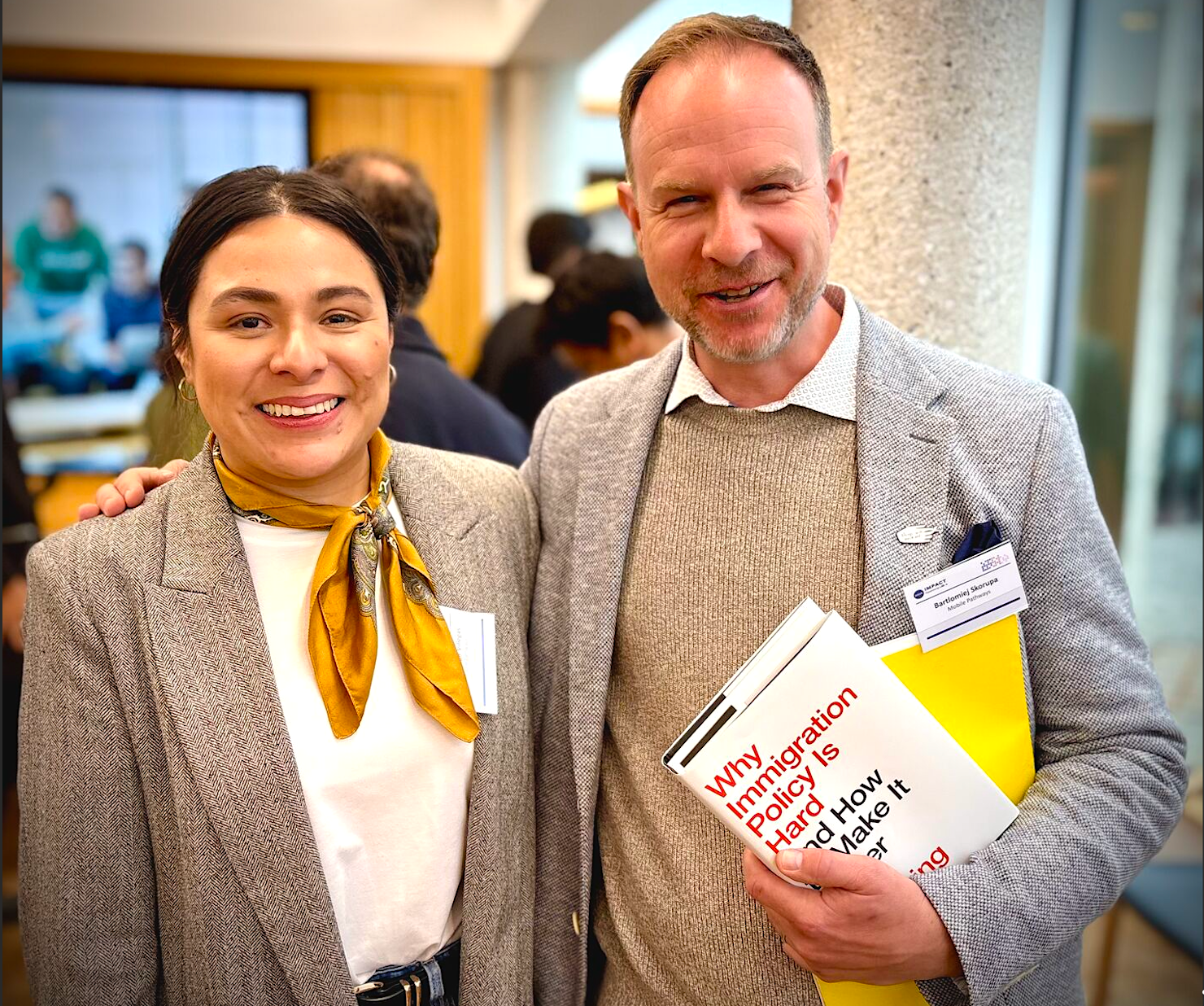
At the LSE, I picked up Alan Manning's Why Immigration Policy Is Hard (And How to Make It Better). I devoured it. My copy is full of margin notes. Manning, an LSE economist and former Chair of the UK's Migration Advisory Committee, lays out with devastating clarity what he calls the "infernal cycle" of immigration policy: governments try to control migration, migrants adapt, the public perceives a loss of control, and the cycle repeats. It should be required reading for every migration advocate, whether you work in the U.S. system or anywhere else.
The frustrated migrant is a global phenomenon. Canada, Germany, the UK, France, Australia, every desirable destination country faces the same structural pressures Manning describes. The need isn't just for more legal representation. It's for systemic intelligence that reveals what is actually happening inside immigration systems so policies can handle migration efficiently and humanely.
The Pathfinder model is exportable. But we earn that future by getting the U.S. model right first.
3. AIDE Debuts at Skoll

The Skoll World Forum wasn't on our radar. Resources are tight, and Oxford in April felt like a luxury we couldn't justify. But attending at the invitation of 100X turned out to be demonstrably transformative.
We debuted AIDE to the world. We unlocked a transformative gift that will fuel the launch of Pathfinder for All sooner than we expected. Conversations with fellow members of the 100X and Fast Forward cohorts who were also there, particularly Karya, Adalat AI, Farmers for Forests, and 1% for the Planet, unlocked new ideas and new pathways to achieving 100X impact.
The energy was infectious. I barely slept.
It was our first Skoll. It won't be our last.


